In the Frayser neighborhood of north Memphis, attendance liaisons knocked on doors last summer and found families who needed immunization updates, bus passes, and someone to ask the question nobody else had asked: why isn't your child in school? Daily attendance in Frayser and South Memphis rose about five percentage points after the outreach push. In Orange Mound, four miles to the southeast, the rate fell from 78% to 63%.
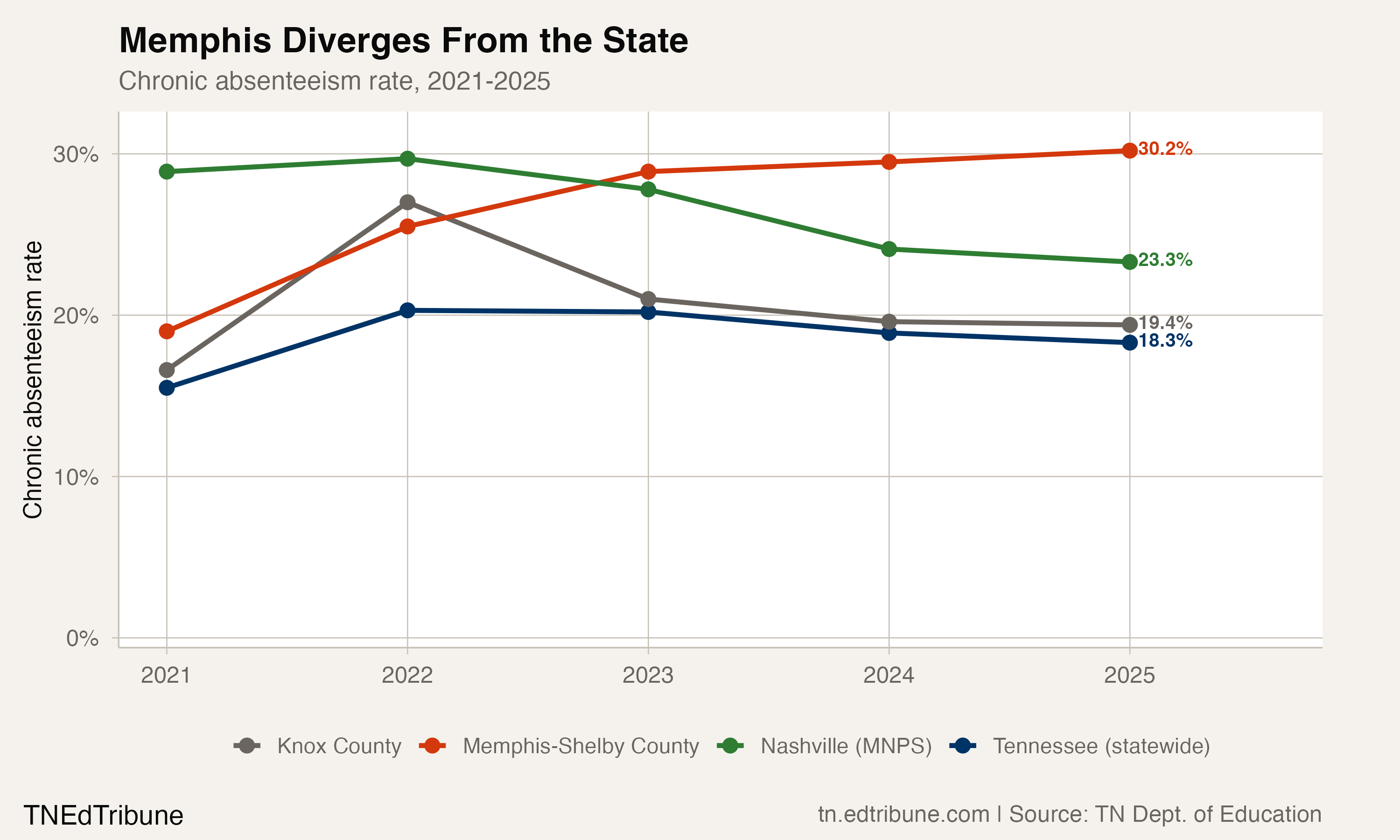
That split captures what chronic absenteeism data in Tennessee now shows at scale. Memphis-Shelby County Schools posted a 30.2% chronic absenteeism rate in 2024-25, the highest on record and the fourth consecutive annual increase. Statewide, the rate fell to 18.3%. Nashville cut its rate by 6.4 percentage points from its 2022 peak. Knox County, Hamilton County, Rutherford County: all improved. Memphis moved in the opposite direction, and the distance between the state's largest district and everyone else is growing.
The four-year climb
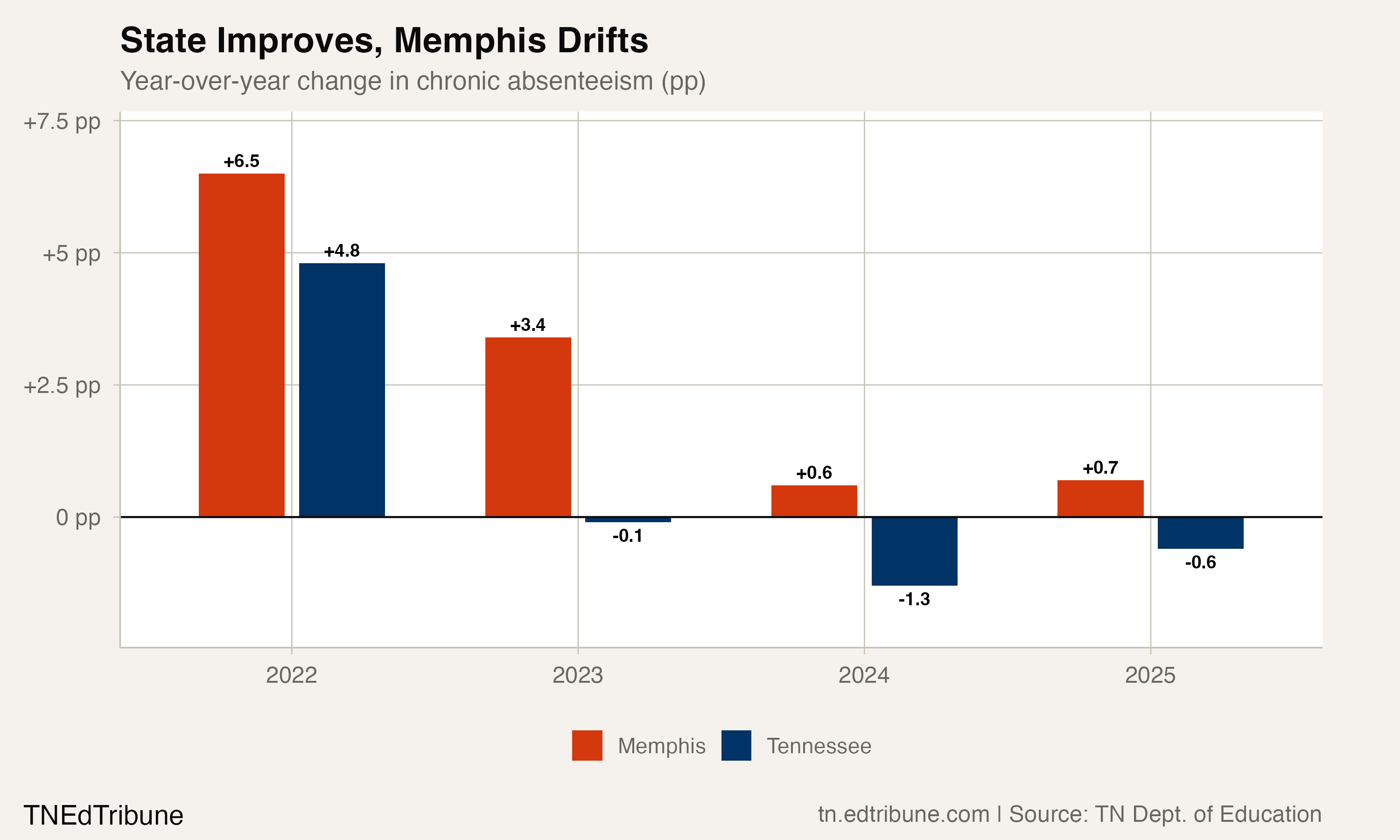
Memphis-Shelby County's chronic absenteeism rate has risen every year in the available data: 19.0% in 2021, 25.5% in 2022, 28.9% in 2023, 29.5% in 2024, and 30.2% in 2025. That 11.2 percentage-point increase happened while the state moved in the opposite direction, dropping from a 20.3% peak in 2022 to 18.3% in 2025.
The rate of worsening has slowed. Memphis gained 6.5 percentage points between 2021 and 2022, then 3.4 the following year. The last two increases, 0.6 and 0.7 points, are smaller. But the direction has not changed, and the district has not posted a year-over-year improvement since the data begins.
In raw numbers, 31,785 of the district's 105,186 students missed more than 18 days of school last year. Memphis enrolls 10.7% of Tennessee's public school students but accounts for 17.6% of all chronically absent students statewide, a disproportionality ratio of 1.7-to-1.
High school is where the problem accelerates
The district-wide 30.2% figure masks a sharp divide between grade levels. Memphis high schools recorded a 38.4% chronic absenteeism rate in 2024-25, up 4.9 percentage points from the prior year. Nearly two in five high schoolers missed more than 18 days.
K-8 schools actually improved slightly, falling from 28.0% to 26.9%. That 1.1-point decline mirrors the direction of the state's K-8 rate, which dropped from 16.8% to 15.9%. Memphis elementary and middle schools are not recovering as fast as the state average, but they are at least moving the right way.
High schools are not. The state's high school rate edged down from 23.8% to 23.6%. Memphis high schools surged from 33.5% to 38.4%. The gap between Memphis high schools and the state high school average widened from 9.7 to 14.8 percentage points in a single year.
"If we address our attendance issues on the front end, that will certainly help us with truancy on the back end." -- Stacey Davis, MSCS director of attendance, Chalkbeat Tennessee, Feb. 2026
The February data reported by Chalkbeat showed nearly 40% of high schoolers on track for chronic absenteeism midway through the 2025-26 school year. Schools designated for Comprehensive Support and Improvement, the state's lowest performers, were running above 40%.
The peer comparison
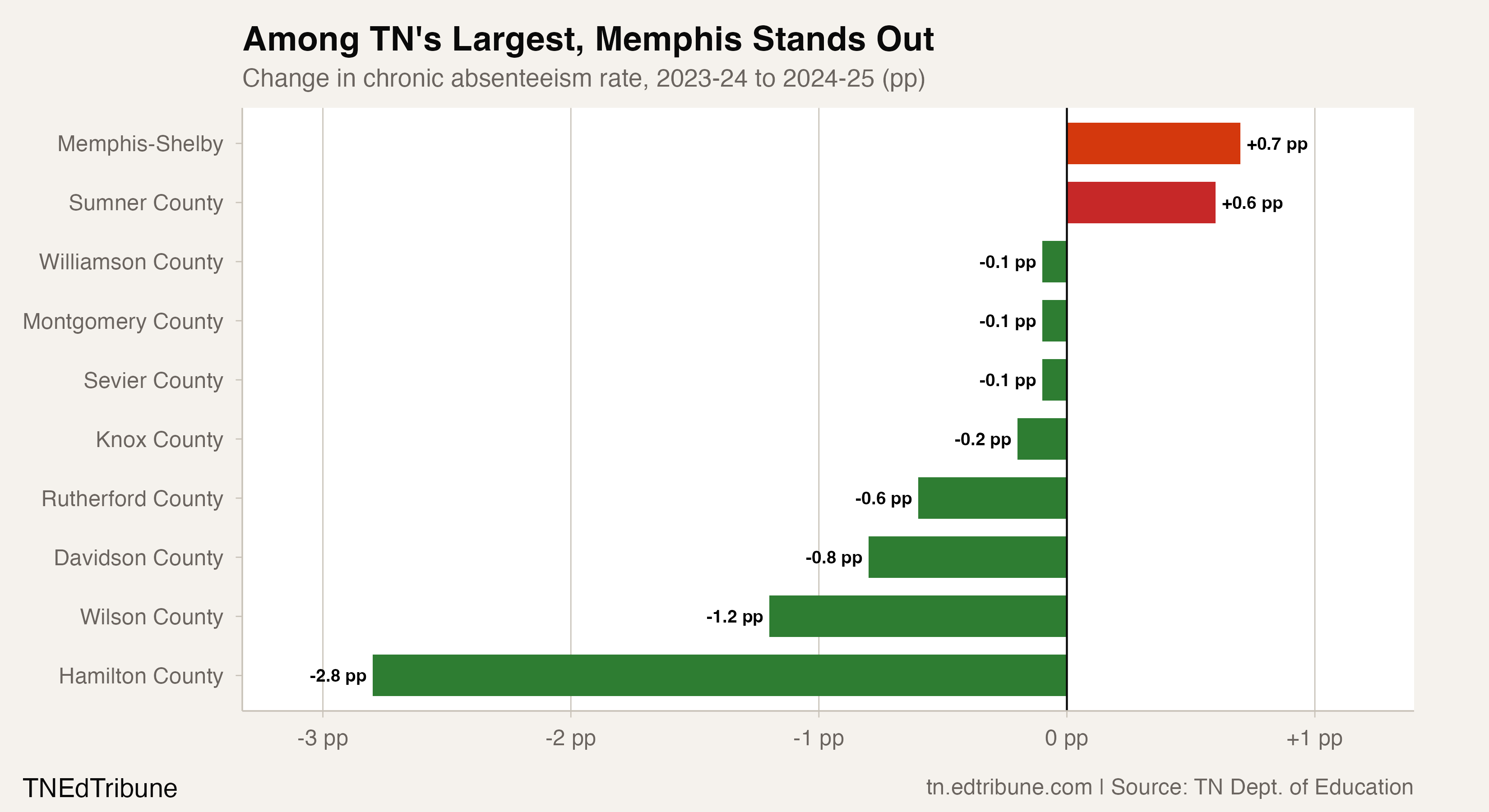
Among Tennessee's 10 largest districts, eight reduced their chronic absenteeism rates between 2023-24 and 2024-25. Hamilton County, which serves Chattanooga, made the largest improvement: a 2.8 percentage-point drop, from 19.9% to 17.1%. Nashville fell 0.8 points. Knox County fell 0.2 points. Even Sumner County, the only other large district to worsen, moved just 0.6 points in the wrong direction from a much lower baseline of 12.2%.
Memphis is not just the only large district getting worse. It is the only large district above 30%.
Nashville's trajectory is the starkest contrast. Davidson County peaked at 29.7% in 2022. Three years later, Nashville is at 23.3%, a 6.4-point recovery. Memphis passed through that same 29% range in 2023 and kept climbing. The two districts crossed paths heading in opposite directions.
Every subgroup, the same gap
Memphis exceeds the state average in every demographic and service-population category. The widest gap belongs to the overall rate itself: 11.9 percentage points above the state. Among racial subgroups, Black students in Memphis face a 33.6% chronic rate compared to 26.5% statewide, a 7.1-point gap. Economically disadvantaged students in Memphis are chronically absent at 36.0%, versus 29.9% statewide.
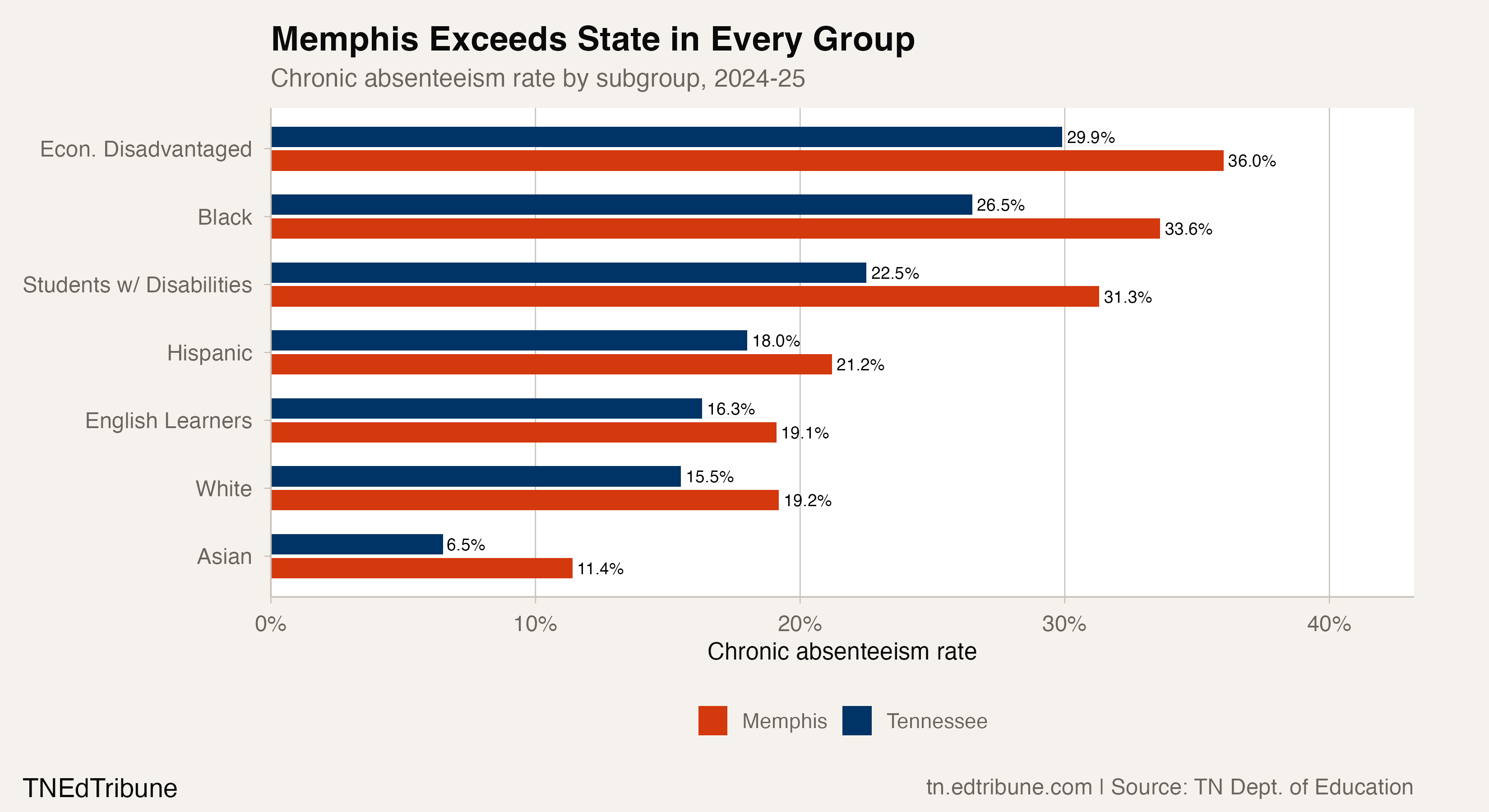
The smallest gaps are among English learners (2.8 points above state) and Hispanic students (3.2 points above state). These are populations where Memphis is closer to the state norm, though still above it. The largest gap by student population: students with disabilities, where Memphis runs 8.8 points higher than the state rate.
$4.4 million and 78 liaisons
Memphis-Shelby County Schools is not ignoring the problem. The district employs 78 attendance liaisons at a cost of $4.4 million per year. A 2024 financial audit committed an additional $2.9 million investment in absenteeism reduction. The "Show Up for Greatness" campaign uses door-knocking, phone calls when a student is marked absent, and community-based outreach.
The summer 2025 push enrolled more than 1,000 unregistered students and improved daily attendance in targeted neighborhoods. But attendance liaisons that previously worked in a single building are now spread across multiple schools, and the results from Orange Mound, where daily attendance dropped 15 percentage points despite the campaign, suggest the interventions do not transfer uniformly across neighborhoods.
The attendance problem sits inside a broader institutional crisis. MSCS lost more than 10,000 students over the past decade, a 9% decline that outpaces both the state's 2.5% drop and the national average. The district voted in February 2026 to close five schools, the first round in a plan to shutter up to 15 buildings by 2028. One in four MSCS schools operates below 60% capacity. Shelby County lost more residents than any U.S. county in 2024, according to Chalkbeat's reporting.
School closures, enrollment decline, and chronic absenteeism interact in ways the data cannot fully separate. A school at 55% capacity with a 40% chronic absenteeism rate is a building where, on any given day, fewer than a third of the desks a designer planned for have a student in them. That shapes the experience of every child who does show up.
What the funding formula sees
Tennessee's TISA funding formula, which replaced the BEP in 2023-24, allocates per-pupil base funding plus weighted supplements for student characteristics. Chronic absenteeism does not reduce a district's allocation directly, but it compounds other fiscal pressures. A district losing enrollment loses per-pupil revenue. A district whose students are absent loses the academic outcomes that trigger TISA's outcome bonuses.
Memphis has both problems simultaneously: flat-to-shrinking enrollment and rising absenteeism. The state's three-tier truancy intervention system escalates from universal prevention to court referral after seven unexcused absences. The court-referral tier was designed for outlier cases. In Memphis, nearly a third of the student body meets or approaches the threshold, which stretches the system past what progressive discipline was designed to handle.
What comes next
The district is targeting a 26.5% chronic absenteeism rate for 2025-26. Midyear data from February 2026 showed 27% of students at high risk, down from 31.5% at the same point the prior year. If the end-of-year rate does fall below 27%, it would be the first improvement in the data's history.
But the high school divide complicates that projection. K-8 rates are already trending downward. High school rates rose by nearly five points in a single year, and the February data showed nearly 40% of high schoolers still on track for chronic absenteeism. The district's western regions, the same areas targeted for school closures, remain above the 26.5% goal.
Seventy-eight liaisons and $4.4 million a year are working against structural forces that have only gotten stronger: a shrinking, high-poverty district closing schools while trying to persuade 30,000 students that showing up matters. Nashville faced a comparable crisis in 2022 and has cut its rate by a quarter since then. The proof that recovery is possible in a large Tennessee urban district already exists. Memphis has not yet found its version of it.
Detailed code that reproduces the analysis and figures in this article is available exclusively to EdTribune subscribers.
Discussion
Sign in to join the discussion.
Loading comments...