Hillcrest High School sits in southeast Memphis, on a stretch of East Shelby Drive between a Dollar General and a Church's Chicken. For the past decade, it has been a ward of the state. Tennessee took control of Hillcrest in 2015 as part of the Achievement School District, the state-run turnaround experiment built on the premise that government intervention could push the state's worst-performing schools into its top quartile within five years.
That never happened. Now the ASD is closing, and its final numbers are in.
In 2024-25, 53.7% of students in the Achievement School District were chronically absent, meaning they missed at least 18 school days. That is nearly triple Tennessee's statewide rate of 18.3% and the highest chronic absenteeism rate of any district in the state. Of the 1,389 students still enrolled, 746 missed enough school to be classified as chronically absent.
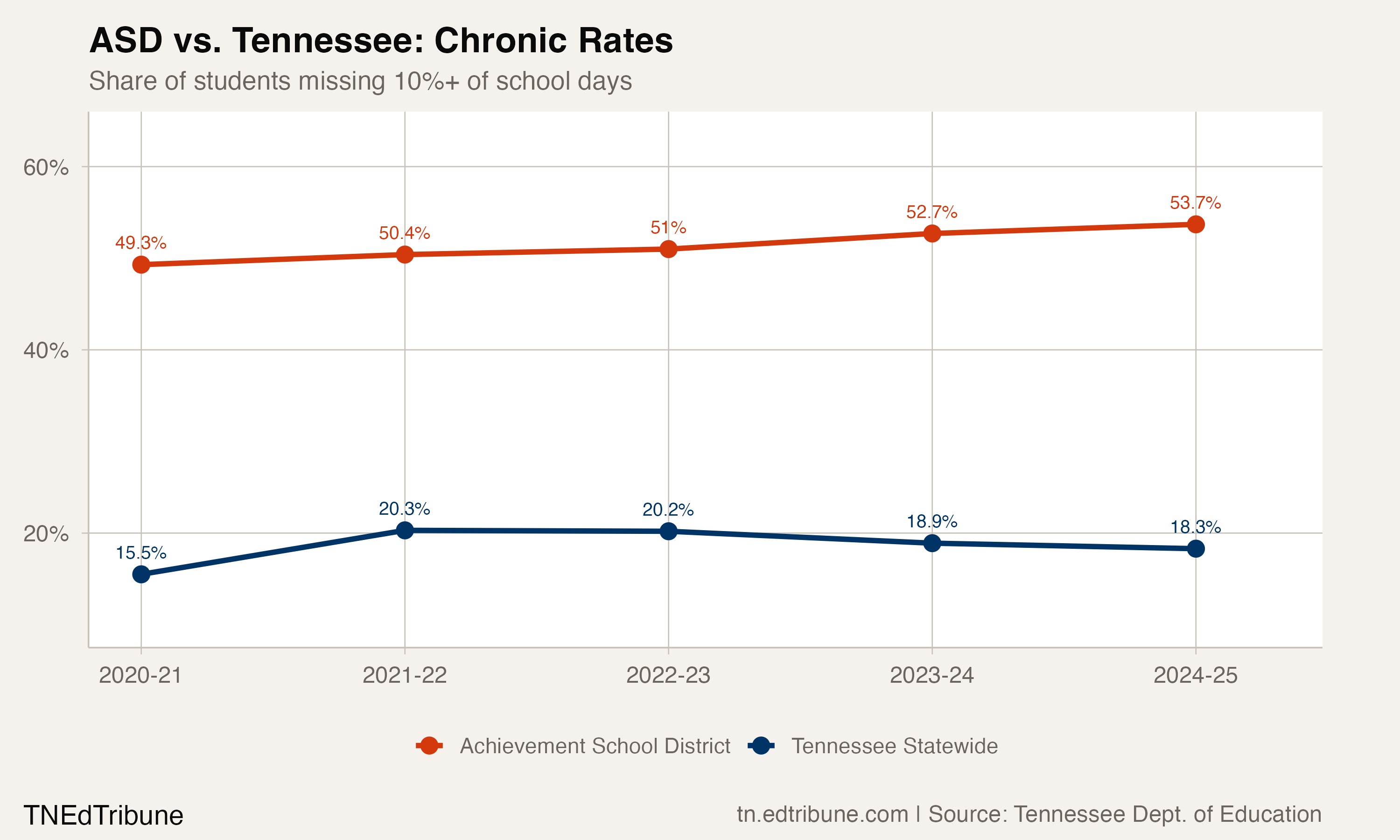
The rate has climbed every year the data exists: 49.3% in 2020-21, 50.4%, 51.0%, 52.7%, and now 53.7%. The ASD has never recorded a year below 49%. While Tennessee's statewide rate peaked at 20.3% in 2021-22 and has since fallen to 18.3%, the ASD moved in the opposite direction, widening the gap from 33.8 percentage points to 35.4.
The enrollment that vanished
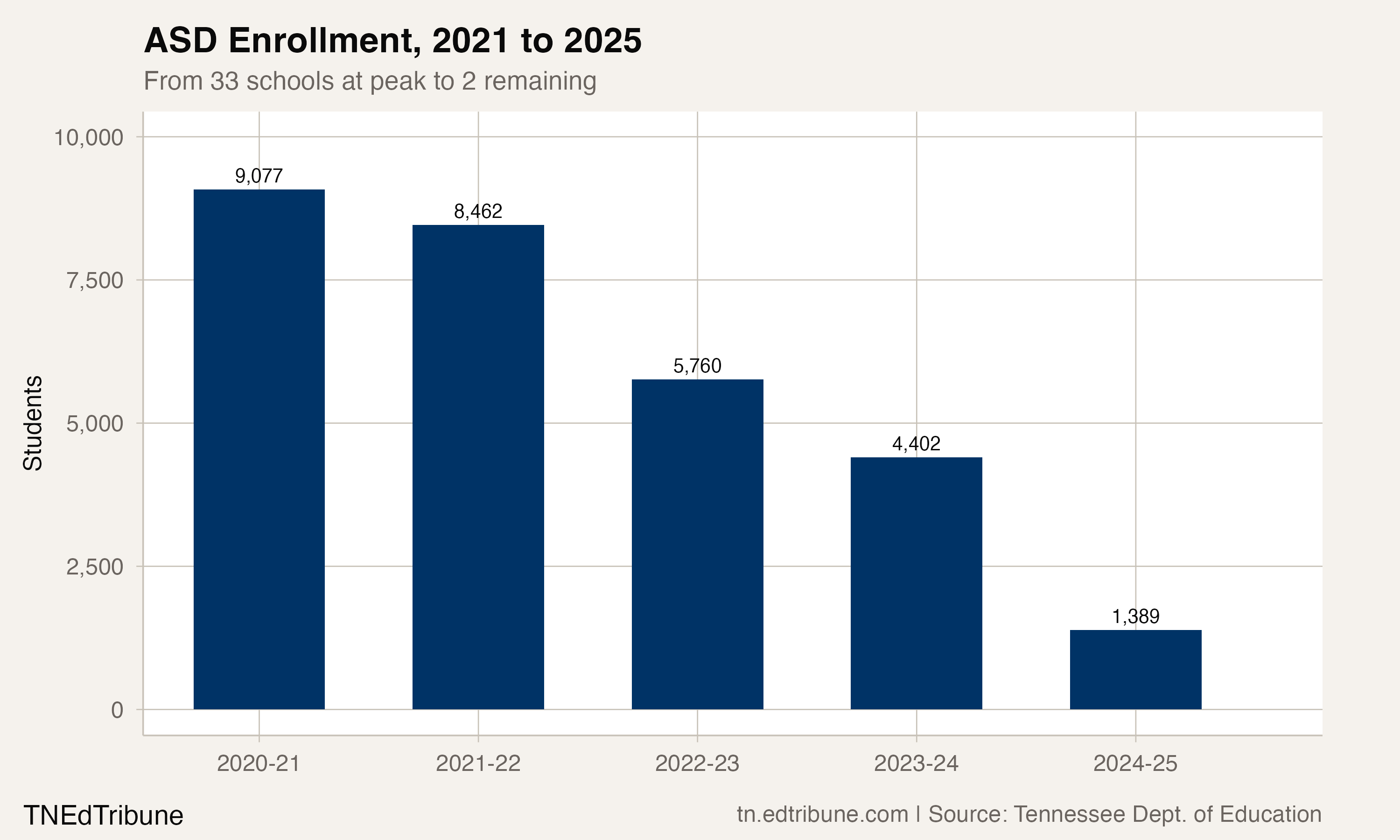
The chronic rate is only part of the picture. The ASD enrolled 9,077 students in 2020-21. Four years later, that number is 1,389, an 84.7% decline. Schools were returned to local districts or transitioned to charter oversight as their 10-year state contracts expired. At its peak around 2016, the ASD oversaw 33 schools serving more than 10,000 students. By 2024-25, two remained: Hillcrest High and Kirby Middle, both in Memphis, both operated by IOTA Community Schools (formerly Green Dot Public Schools Tennessee).
The schools that left the ASD didn't leave because they were fixed. Research published in 2024 by a team led by Lam Pham at North Carolina State University, through Brown University's Annenberg Institute, found that ASD assignment "generally worsened high school test scores" and that neither the ASD nor Tennessee's Innovation Zone program "significantly improved ACT scores or high school graduation rates."
"Our accountability systems need other measures so that educators respond more holistically to improving long-term student outcomes." -- Chalkbeat Tennessee, Nov. 2024
That study examined students through 2017-18, meaning the ASD's final years of operation may tell a different story. But the chronic absenteeism data from those final years does not suggest improvement.
Who is still there
The 1,389 students who remain in the ASD are overwhelmingly Black (1,029 students, 74.1% of enrollment) and disproportionately low-income. Every subgroup in the ASD exceeds the statewide chronic rate by a wide margin.
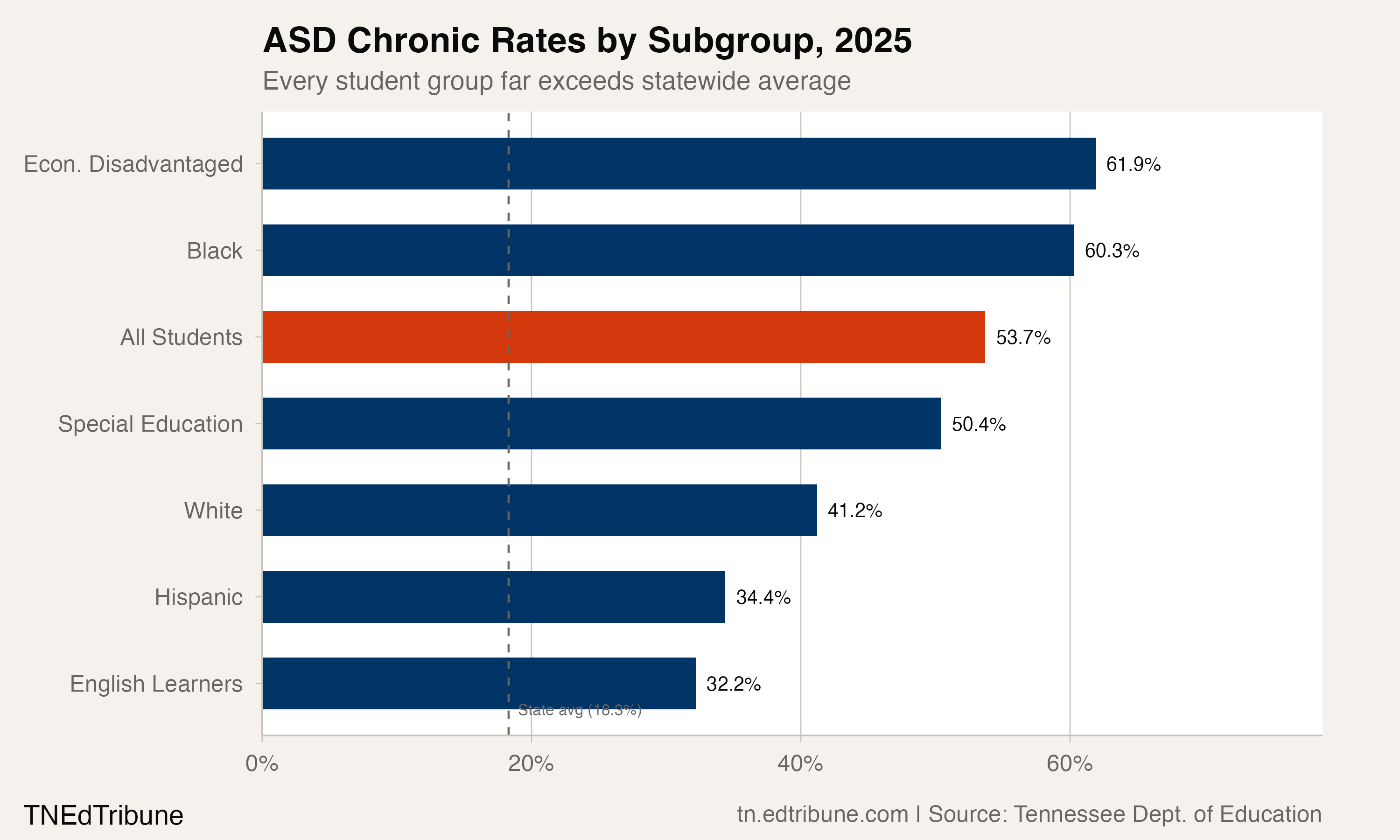
Economically disadvantaged students, who make up 54.4% of the remaining ASD enrollment, post a 61.9% chronic rate, more than three times the statewide average. Black students face a 60.3% rate. Even the ASD's English learners, who often have lower absence rates in other districts, are chronically absent at 32.2%, nearly double the state rate.
The small enrollment makes these numbers volatile. With 17 white students, the 41.2% white chronic rate represents seven students. But the pattern across larger groups is consistent: every population in the ASD misses school at rates that would place them among the worst in any Tennessee district.
A decade, a billion dollars, a 5% math proficiency rate
Tennessee created the Achievement School District in 2010 as part of its successful Race to the Top application, which brought $500 million in federal funding. Chris Barbic, founder of the YES! Prep charter network in Houston, became the ASD's first superintendent in 2011. The founding goal was to move schools from the bottom 5% of state performance to the top 25% within five years.
The model removed schools from local district control and handed them to charter operators under 10-year contracts. Most of the schools were in Memphis, with a smaller number in Nashville. Community backlash was immediate and sustained, particularly around the racial dynamics of outside organizations taking over predominantly Black neighborhood schools.
Barbic himself acknowledged the depth of the challenge: "We underestimated that," he said of the generational poverty concentrated in the communities the ASD served.
By 2024, lawmakers on both sides of the aisle were ready to end the experiment. The Tennessee General Assembly passed the shutdown legislation with a 75-15 House vote in April 2025. Rep. Antonio Parkinson, a Memphis Democrat, called the ASD a "catastrophe of an experiment in education, served on the backs of our communities." The program cost taxpayers over $1 billion.
Hillcrest's math proficiency rate stands at 5%. Its graduation rate of 68.4% trails the Memphis-Shelby County Schools district average of 81.1%. Both Hillcrest and Kirby have received the lowest possible TVAAS growth scores for three consecutive years.
In October 2025, the Tennessee Charter School Commission upheld the denial of IOTA's application to continue managing the two schools for another decade. Commission Chair Chris Richards was blunt: "We've been 10 years into this, and we continue to have this low-performing school."
The three-line chart
Placing the ASD alongside Memphis-Shelby County Schools and Metro Nashville Public Schools reveals how far the turnaround district sits from even the state's most challenged urban systems.
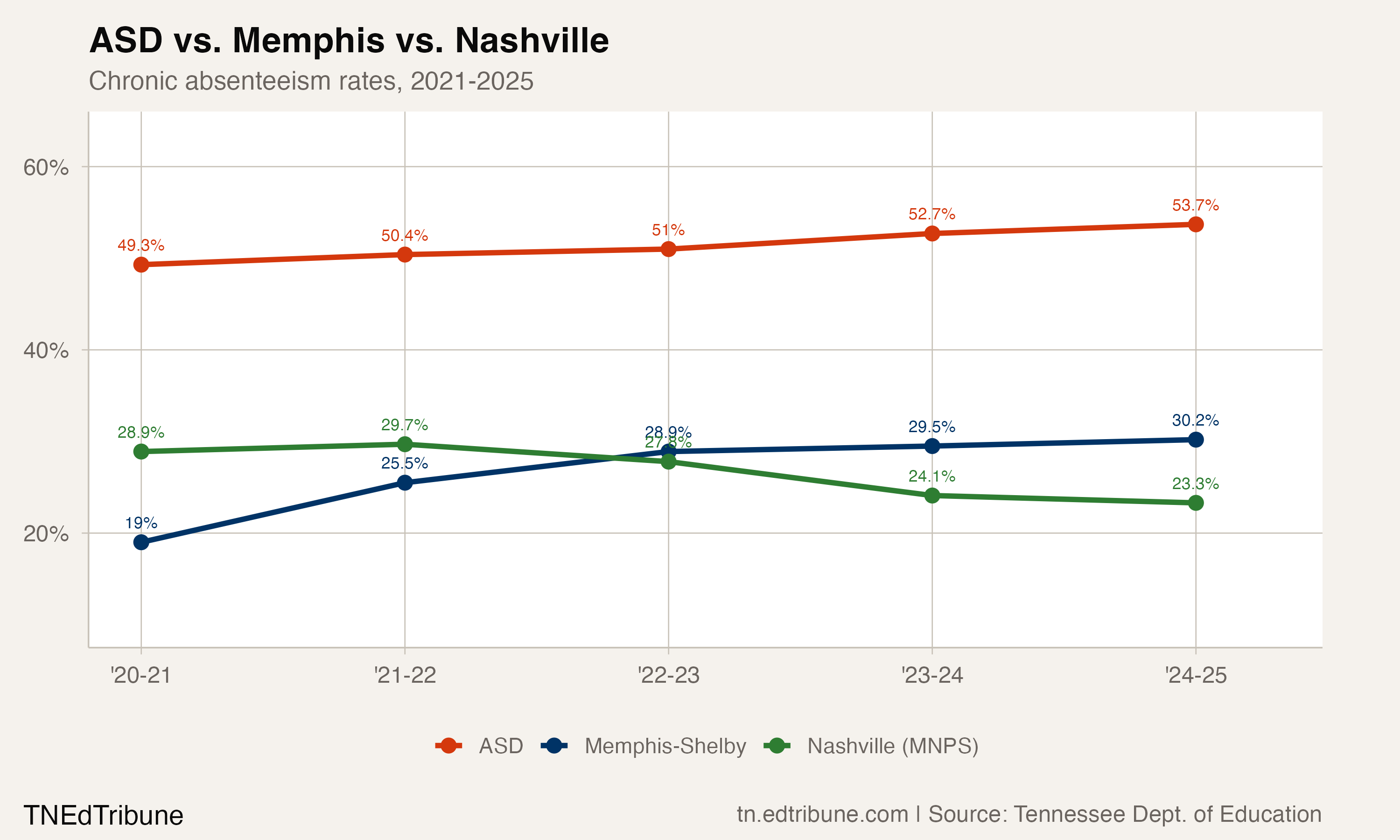
Nashville's chronic rate has fallen from 28.9% to 23.3% since 2020-21, a 5.6 percentage-point improvement. Memphis has worsened from 19.0% to 30.2% over the same period. The ASD, at 53.7%, occupies a different stratum entirely. Its rate is 23.5 percentage points above Memphis and 30.4 above Nashville.
The gap is not solely a function of the ASD's demographics. Memphis-Shelby County Schools serves a student body that is majority Black and majority low-income, and its chronic rate, while high, is 23.5 points below the ASD's. The two remaining ASD schools draw from the same southeast Memphis neighborhoods as surrounding MSCS campuses. Some of the difference may reflect selection: families with the most stable attendance patterns may have been the first to transfer out as ASD enrollment shrank. But a 23.5-point gap between schools serving the same zip codes points to something beyond demographics.
What replaces it
The ASD's closure does not mean Tennessee is abandoning intervention in low-performing schools. The same legislation that shuttered the ASD created a three-tiered system that gives local districts more autonomy. Under Tier 1, districts choose their own evidence-based strategies. Tier 2 options include charter conversion or higher education partnerships. Tier 3 allows school closures or state-directed staff replacement.
Sen. Jack Johnson, the bill's sponsor, framed it as a course correction: "This new structure will maintain accountability while allowing school systems to pursue turnaround models that reflect their unique challenges."
Parkinson was less sanguine. "They're saying they're ending the ASD," he told Chalkbeat, "but all they're doing is redoing the ASD on a much larger scale."
For the 1,389 students at Hillcrest and Kirby, the transition means returning to Memphis-Shelby County Schools in fall 2026. Approximately 68% of Hillcrest students qualify as economically disadvantaged and rely on therapy services, social workers, and meal programs provided through the school. Commissioner Terence Patterson, who voted to deny IOTA's charter renewal, acknowledged the bind: "It is unrealistic to ask parents to drive seven miles to a high-performing option."
The question for those 1,389 students is whether returning to local control will make any measurable difference in whether they show up. The ASD was built on the theory that governance structure drives outcomes. A decade of data suggests it does not, at least not in the way its architects imagined. Memphis-Shelby County Schools, which will inherit these students, is itself struggling with the worst chronic absenteeism trajectory among Tennessee's major districts. The students are not moving to a system that has solved the problem. They are moving to one that is 23.5 percentage points closer to solving it.
Detailed code that reproduces the analysis and figures in this article is available exclusively to EdTribune subscribers.
Discussion
Sign in to join the discussion.
Loading comments...