In Knox County, 29.3% of Black students were chronically absent in 2024-25. The district's overall rate was 19.4%. That 9.9 percentage-point gap means a Black ninth-grader in Knoxville is nearly twice as likely to miss 18 or more days of school as the average student sitting in the next classroom. Knox County is not unusual. Across Tennessee, the gap between Black students and the statewide average runs between 8 and 12 points in every large district.
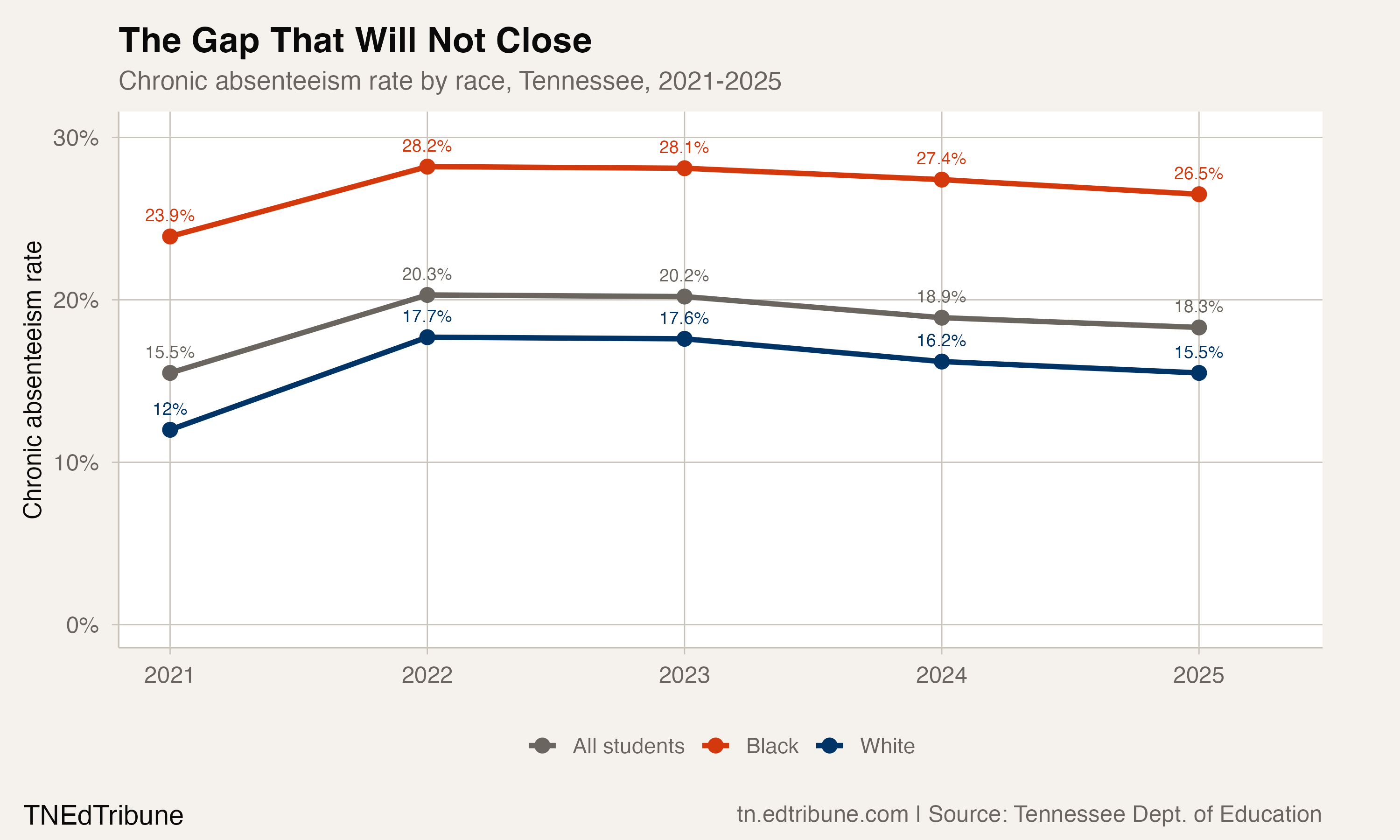
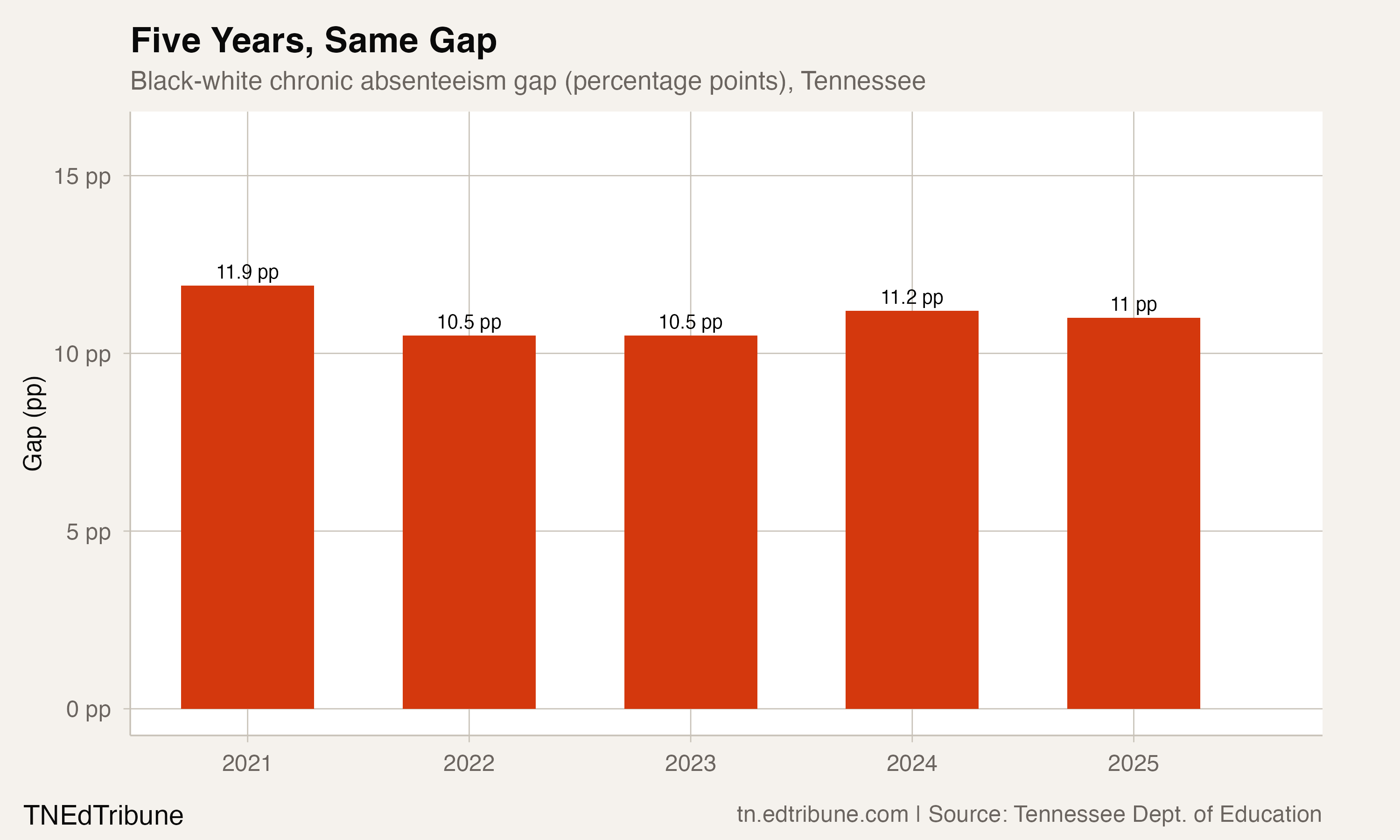
The state's 235,490 Black students posted a 26.5% chronic absenteeism rate in 2024-25, the highest of any racial group. White students, who outnumber Black students more than two to one, posted 15.5%. The difference, 11.0 percentage points, has barely moved since the state began publishing comparable data: 11.9 points in 2020-21, 10.5 in 2021-22, 10.5 in 2022-23, 11.2 in 2023-24, 11.0 now.
Five years. Same gap. Every year the state's overall rate improves, Black students improve at roughly the same pace, and the distance between the lines holds steady.
The math of disproportionality
Raw rates tell part of the story. Shares tell the rest.
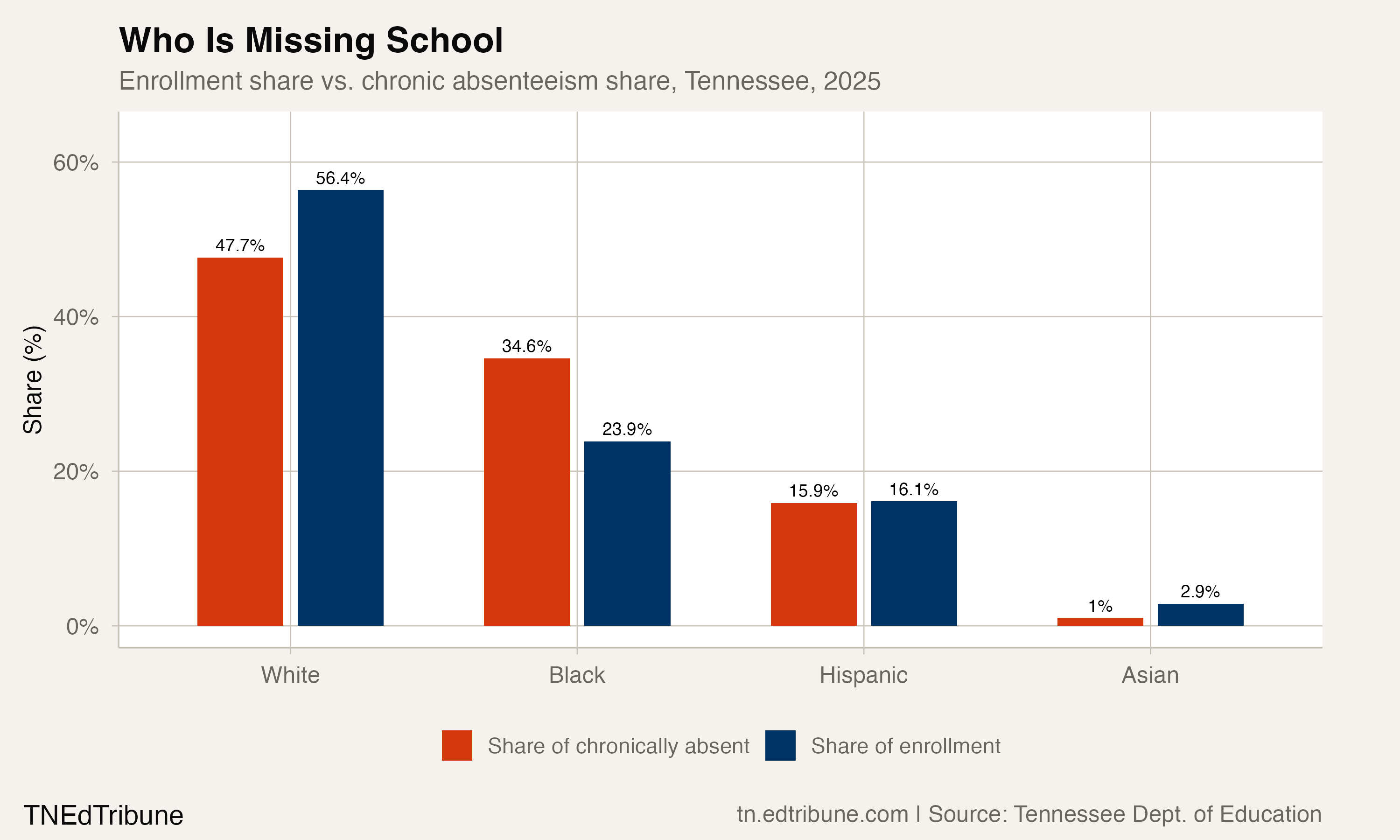
Black students are 23.9% of Tennessee's K-12 enrollment but account for 34.6% of all chronically absent students statewide, a disproportionality ratio of 1.45 to 1. In practical terms, 62,413 Black children missed more than 18 days of school last year. White students, at 56.4% of enrollment, accounted for 47.7% of the chronically absent population, a ratio of 0.85 to 1, meaning they are underrepresented among the chronically absent relative to their enrollment share.
Hispanic students, 16.1% of enrollment and 15.9% of chronic absences, track almost exactly proportional. Asian students, at 2.9% of enrollment and 1.0% of chronic absences, are the most underrepresented, with a 6.5% chronic rate that is less than a quarter of the Black rate.
The disproportionality ratio has actually risen in recent years. In 2020-21, Black students were 1.54 times overrepresented, but that year's ratio was inflated by the pandemic disruption hitting Black communities hardest. It dropped to 1.38 in 2021-22 as all groups surged, then climbed back to 1.45 by 2023-24 and held there through 2024-25. The gap did not widen because Black students got worse. It widened because other groups recovered faster.
A tale of two districts
Memphis-Shelby County Schools and Nashville's Davidson County together enroll more than half of all Black students in Tennessee's urban core. Their trajectories since 2021 could not be more different.
In Memphis, Black students posted a 21.4% chronic rate in 2020-21. By 2024-25, it reached 33.6%, an increase of 12.2 percentage points across four years. More than one in three of Memphis's 77,713 Black students, 26,137 children, missed 18 or more days of school. The trajectory has not reversed: 21.4%, 28.5%, 31.8%, 33.0%, 33.6%. Each year worse than the last.
Nashville moved in the opposite direction. Davidson County's Black chronic rate peaked at 37.5% in 2021-22 and fell to 29.7% by 2024-25, a 7.8 percentage-point improvement. Nashville is still above the state average for Black students, but the decline is the steepest sustained recovery of any large district in the state.
The contrast matters because Memphis and Nashville face similar structural conditions: high-poverty urban districts, majority-minority enrollment, comparable per-pupil funding under TISA. What differs is trajectory, and trajectory is what determines whether 26,137 chronically absent Black students in Memphis become 30,000 or 20,000.
Memphis-Shelby County Schools↗ET is targeting 26.5% for 2025-26, which would be the first improvement in the data's history. The district has invested heavily in attendance liaisons and door-knocking campaigns. But midyear data from February 2026 showed nearly 40% of high schoolers on track for chronic absenteeism, and the most common barriers families reported were immunization paperwork and transportation -- not disengagement.
High school doubles down on the gap
The racial gap in chronic absenteeism is not the same at every grade level. In K-8, Black students post a 23.9% chronic rate compared to 13.6% for white students, a 10.3 percentage-point gap. In high school, both rates are higher, but the gap widens: 32.5% for Black students versus 19.6% for white students, a 12.9 point spread.
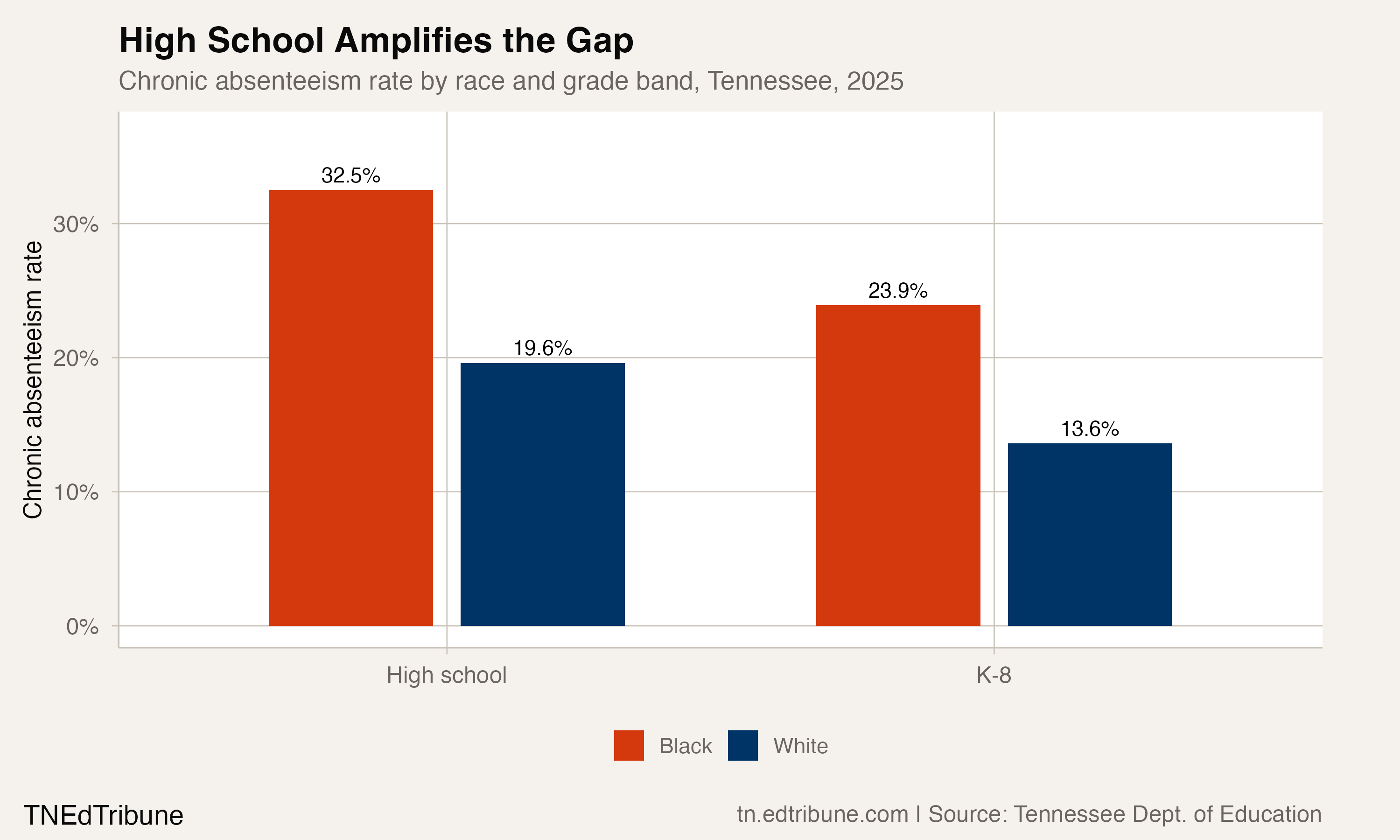
Nearly one in three Black high schoolers in Tennessee is chronically absent. That number, 23,374 students, is roughly the enrollment of a mid-sized Tennessee district. The Tennessee Comptroller's Office found that high school seniors are chronically absent at nearly double the rate of freshmen. For Black students, who already enter high school at elevated absence rates, the senior-year pattern compounds further.
The high school penalty may reflect a compounding of barriers. Older students are more likely to hold part-time jobs, provide child care for siblings, lack reliable transportation of their own, or disengage from schools where they feel unsupported. These factors do not affect all groups equally. Research on discipline disparities shows that Black students in Tennessee are 4.9 times as likely to receive an out-of-school suspension as white students. Every suspension day is, by definition, an absent day.
The slowest recovery
Tennessee's overall chronic absenteeism rate peaked at 20.3% in 2021-22 and has since fallen to 18.3%, a 2.0 percentage-point recovery. White students recovered 2.2 points from their peak. Hispanic students also recovered 2.2 points. Black students recovered 1.7 points, the smallest improvement of any major racial group.
The 2024-25 Black rate of 26.5% is still 2.6 points above where it was in 2020-21, the earliest year in the dataset. The white rate of 15.5% in 2024-25 is 3.5 points above its 2020-21 mark of 12.0%. Both groups remain above their pandemic-era starting point, but Black students have clawed back less of the ground lost during the COVID spike.
This pattern is consistent with national trends. Word in Black reported that Black students nationally represented roughly 37% of chronically absent students despite being about 15% of enrollment, and that recovery has been slowest in the communities with the highest baseline rates. Carl Felton III, a policy analyst at EdTrust, noted that addressing chronic absenteeism requires more than enforcement: "Support looks like more than just making them go to school."
Three forces, one gap
The 11-point gap has held steady for five years. That stability is itself the finding. The state's chronic absenteeism interventions, its COSI accountability score, its three-tier truancy system that escalates from prevention to court referrals, and its TISA funding formula that ties attendance to dollars have all been operating across this period. None has dented the racial gap, even as the overall rate has improved.
The data does not reveal why. Poverty is a strong candidate: 27.3% of Black children in Tennessee live in poverty compared to 8.8% of white children, and economically disadvantaged students post a 29.9% chronic rate statewide. But the overlap between race and poverty is not total, and the gap persists even in districts where the overall poverty rate is relatively low.
Health barriers are another plausible factor. Black Americans are nearly 1.5 times more likely to be diagnosed with asthma than other racial groups, and five times more likely to visit an emergency department because of it. Each missed day for a health appointment or illness registers in the same attendance column as a day skipped for disengagement.
Discipline is a third channel. The 4.9x suspension rate for Black students in Tennessee means that the school system itself is generating a share of the absent days it then counts as chronic absenteeism. A student suspended for three days three times in a year has nine absent days before any illness, family crisis, or transportation breakdown enters the picture.
Where 62,413 students go from here
Memphis-Shelby County Schools' attendance engagement specialists are addressing root causes including housing insecurity, healthcare access, and basic hygiene needs. Nashville's partnership with Vanderbilt University has produced a student absenteeism working group studying what interventions work at scale. Both are promising. Neither has closed the racial gap.
Five years of data, two statewide improvement cycles, and the 11-point gap did not budge. The interventions Tennessee has deployed -- truancy notices, attendance liaisons, accountability scores -- improved the overall rate. They did not touch the disparity. That pattern points toward causes the education system did not create and cannot address alone: poverty concentration, health care access, and a discipline pipeline that generates absent days while measuring them.
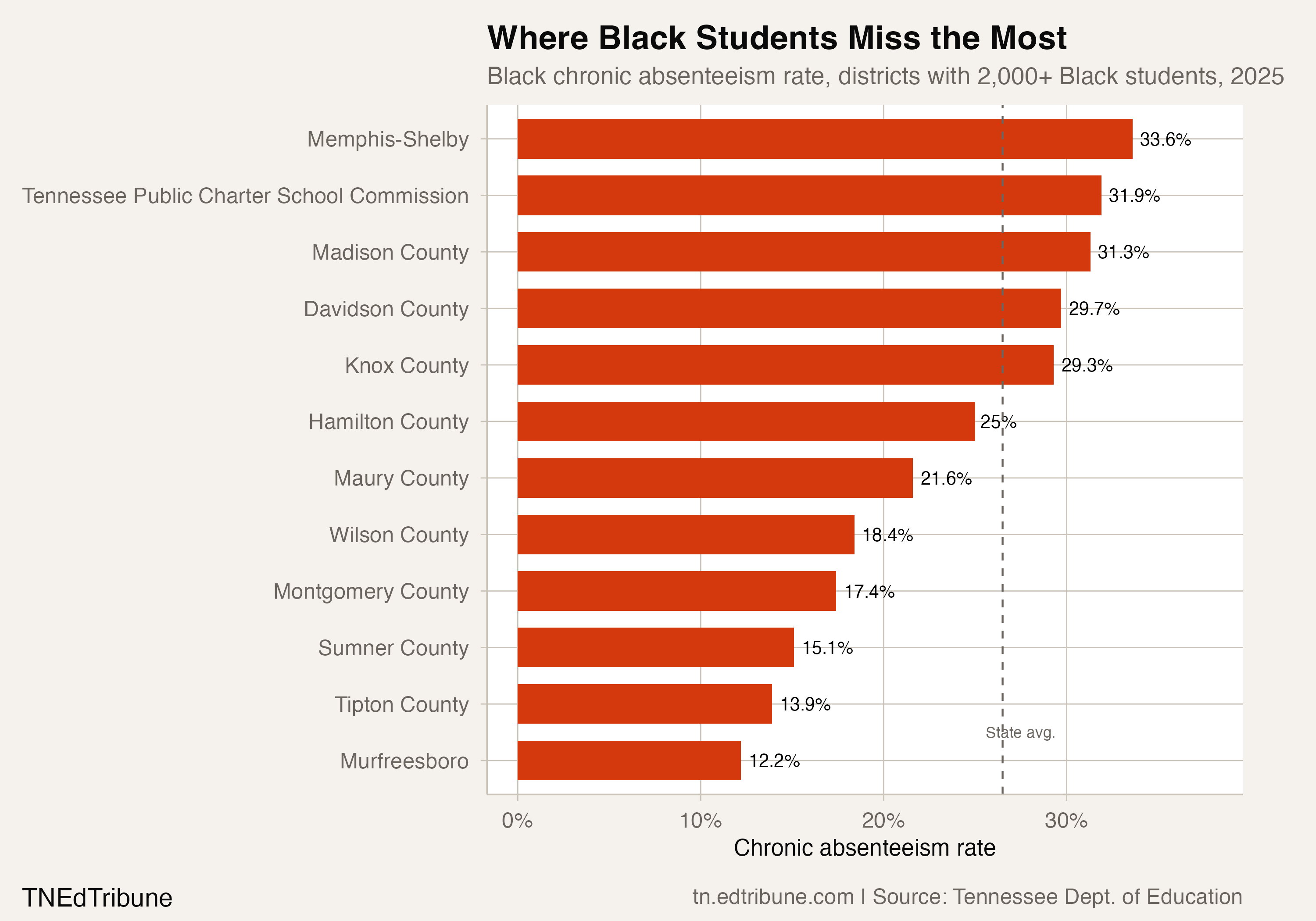
The district-level data offers one clue. Montgomery County, which enrolls 12,739 Black students, posts a 17.4% Black chronic rate, nearly half of Memphis's 33.6%. Rutherford County, with 10,763 Black students, posts 12.1%. Whatever Montgomery and Rutherford are doing differently, or whatever conditions they offer that Memphis and Knox County do not, 62,413 families would like to know.
Detailed code that reproduces the analysis and figures in this article is available exclusively to EdTribune subscribers.
Discussion
Sign in to join the discussion.
Loading comments...