Correction (July 23, 2026): An earlier version of this article said that under Tennessee's TISA funding formula every absent day reduces a district's Average Daily Membership and its funding. The formula defines that measure from the days a student is enrolled, not the days attended, so daily absences do not directly reduce it.
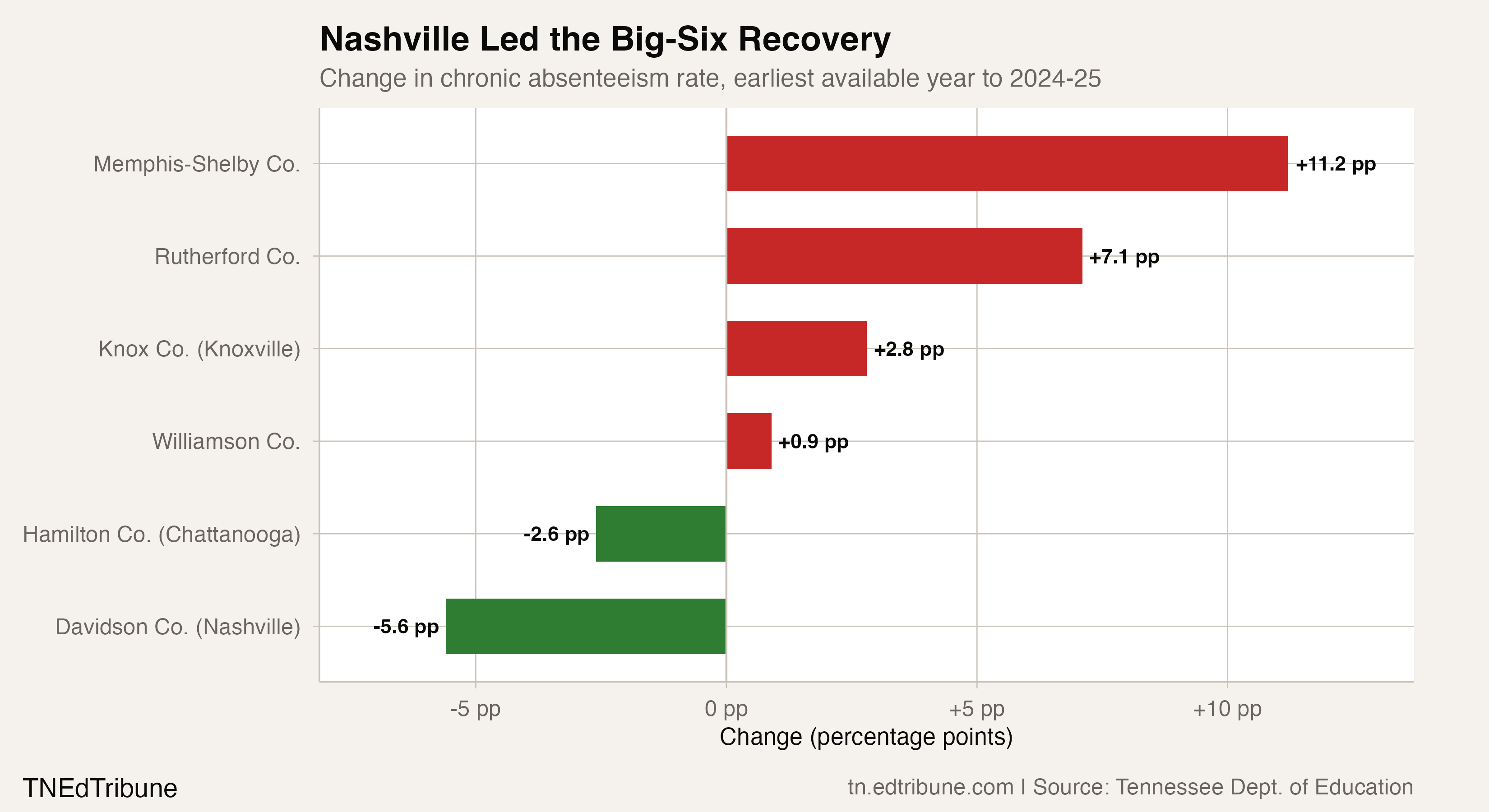
Of Tennessee's six largest school districts, only two have actually reduced chronic absenteeism since 2020-21. One is Hamilton County in Chattanooga, which dropped 2.6 percentage points. The other is Davidson County, home to Metro Nashville Public Schools, which dropped 5.6 points, the biggest improvement in the group by a wide margin.
Memphis-Shelby County went the other direction, climbing from 19.0% to 30.2%. Knox County in Knoxville worsened by 2.8 points. Rutherford County, southeast of Nashville, more than doubled from 4.2% to 11.3%.
Nashville's improvement is real. It is also misleading if you stop at the headline number.
Who recovered and who didn't
The district's overall chronic absenteeism rate fell from 28.9% in 2020-21 to 23.3% in 2024-25. Nearly one in four Nashville students still missed 10% or more of the school year, but the trajectory is unmistakably downward, and the district closed a 13.4-point gap with the state average to just 5.0 points.
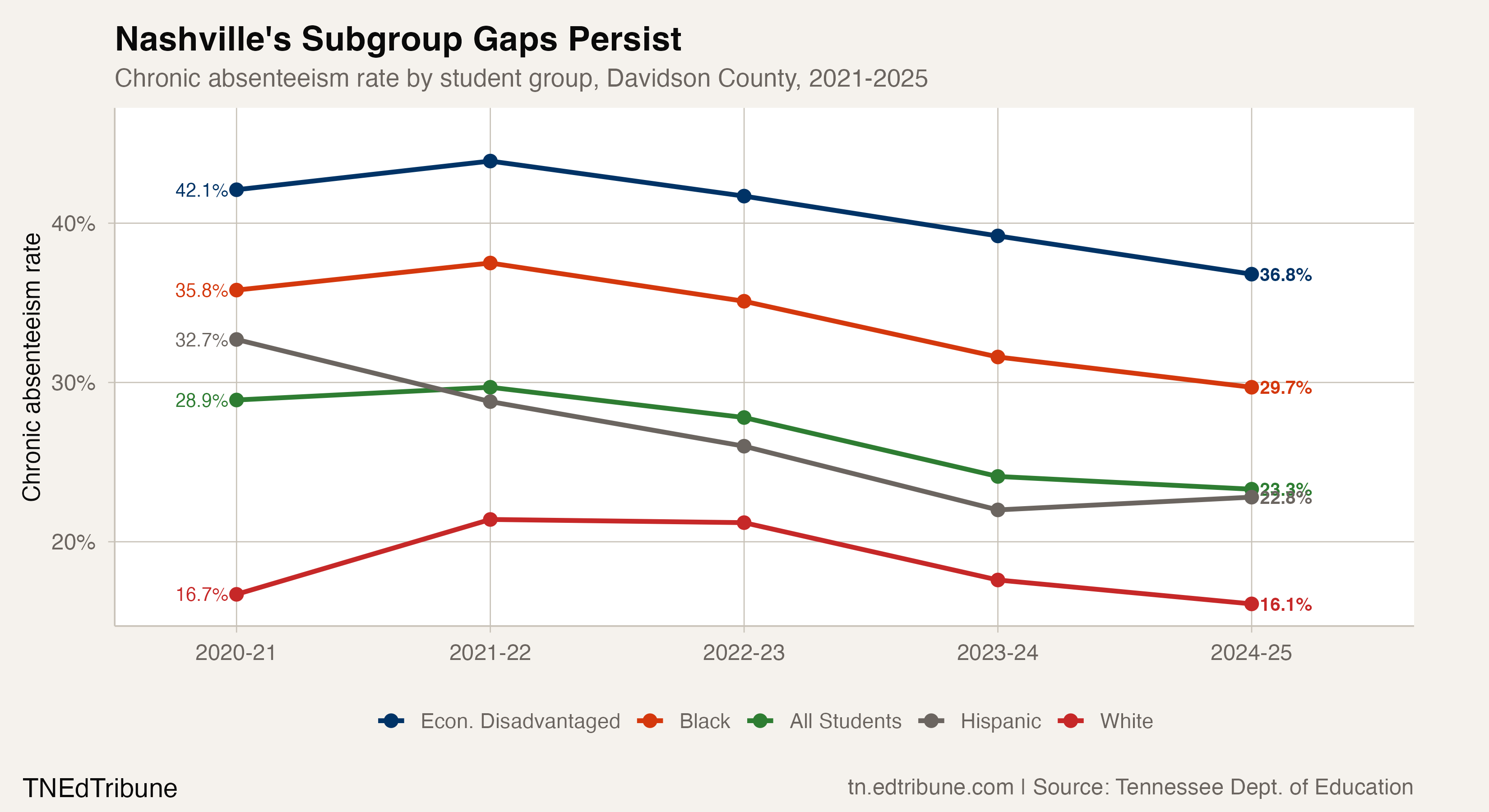
The subgroup picture tells a different story. English learners improved fastest: their chronic rate dropped 11.9 points, from 32.4% to 20.5%. Hispanic students improved by 9.9 points. Black students improved by 6.1 points.
White students barely moved. Their rate fell 0.6 points, from 16.7% to 16.1%.
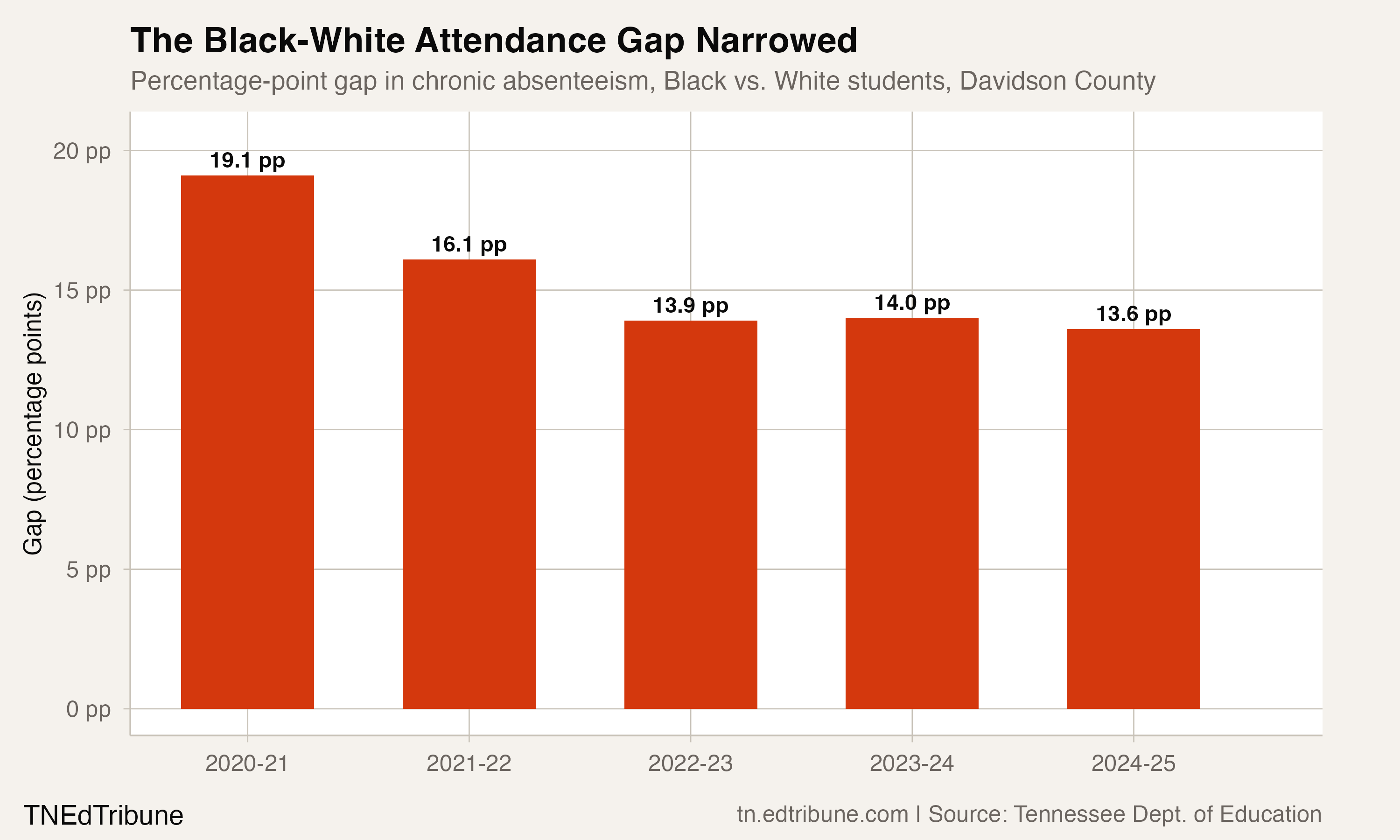
That arithmetic means the Black-white gap narrowed from 19.1 percentage points to 13.6. But it narrowed mostly because Black students' rate came down, not because the gap itself became a target. In 2024-25, nearly three in 10 Black students in Nashville were chronically absent. At 29.7%, Black students' rate remains almost double the white rate of 16.1%.
A gap that held steady where it hurts most
Economically disadvantaged students showed the smallest proportional improvement of any major group. Their rate fell 5.3 points, from 42.1% to 36.8%, but the gap between low-income students and the district average barely budged: 13.2 points in 2021, 13.5 points in 2025.
More than one in three low-income Nashville students were chronically absent last year. That rate, 36.8%, sits nearly 7 points above the statewide average for economically disadvantaged students (29.9%).
The economically disadvantaged count also shifted. Nashville reported 32,288 economically disadvantaged students in 2021 and 25,594 in 2025, a decline of 6,694. Whether that reflects families leaving, reclassification, or changes in eligibility determination is not clear from the data alone. If the students who left the classification were closer to the threshold, the remaining pool would be poorer and harder to serve, making the rate improvement more impressive than it appears.
What Nashville built
The district's recovery did not happen by accident. MNPS has layered interventions at multiple levels: Attendance Intervention Plans triggered after seven missed days, a progressive truancy strategy coordinated with state law, and school-level attendance leads responsible for monitoring and outreach.
A Nashville PEER report documented both the infrastructure and its limits. Only 25% of 126 students served by the district's Homeless Education Resource Office had Attendance Intervention Plans created, despite qualifying for them. Six of seven attendance leads interviewed said they struggled to implement the strategy fully because of competing responsibilities.
In January 2025, Vanderbilt University and MNPS launched a $450,000 collaborative research project to study what is working and what is not. Carol Brown, MNPS's Director of Attendance Services, described the partnership as "key to strengthening our tiered systems for preventing absenteeism and to developing sustainable, innovative support infrastructures."
That the district is investing in understanding its own attendance machinery, rather than declaring victory, is itself a signal. Nashville knows the headline number overstates the progress.
The high school problem
Nashville's K-8 chronic rate fell from 25.2% to 18.4%, a 6.8-point improvement. The high school rate fell less, from 38.0% to 34.9%, and it actually reversed course in 2024-25, climbing 1.7 points after two years of improvement. More than one in three Nashville high school students were chronically absent last year.
The high school reversal coincided with a difficult year for some Nashville high schools. Nashville Banner reporting documented attendance declines at Cane Ridge High School, where chronic absenteeism hit 40% by spring, and John Overton High School, where the rate rose from 28% to 32% over the course of the year. Both schools serve large immigrant populations in southeast Nashville. An attendance counselor told the Banner that families said: "We are terrified... I want my kid to get an education, but it's not worth risking our family."
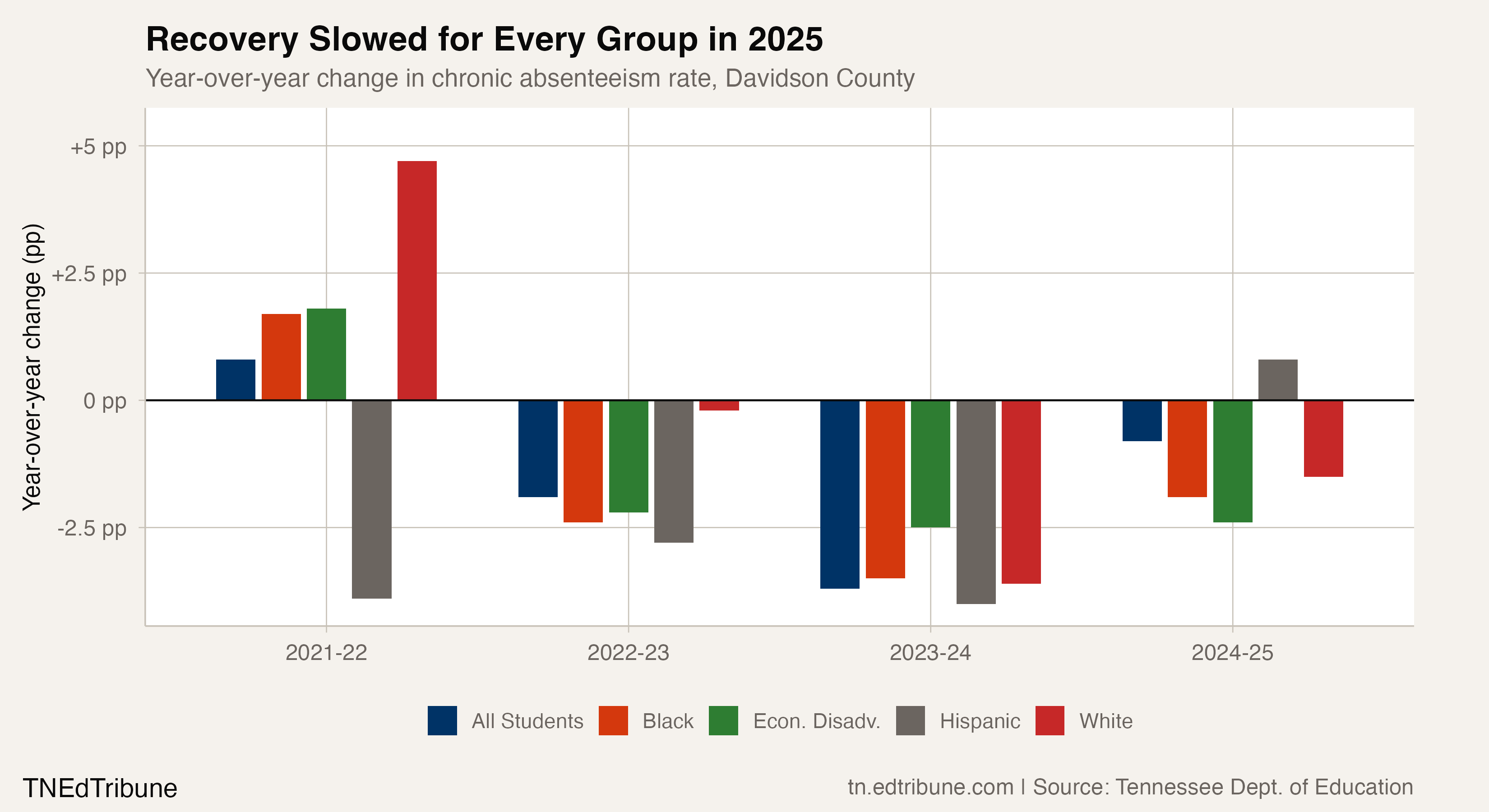
Hispanic students' chronic rate ticked up 0.8 points in 2024-25 after three straight years of improvement. The data cannot separate immigration enforcement effects from other causes, but the timing is consistent with what schools reported on the ground.
The Memphis contrast
Nashville's trajectory looks even sharper next to its largest peer. Memphis-Shelby County Schools, with 105,186 students, posted a 30.2% chronic rate in 2024-25, up 11.2 points from Shelby County's 19.0% in 2020-21. Memphis is the only district in Tennessee's big six where chronic absenteeism worsened every year over the available data.
Nashville and Memphis started the period with similar overall rates, within 10 points. They now sit 7 points apart, moving in opposite directions. What separates the two districts, whether it is intervention design, resource allocation, community infrastructure, or demographic composition, is a question the Vanderbilt research project may eventually help answer.
5 points from the state, and stuck
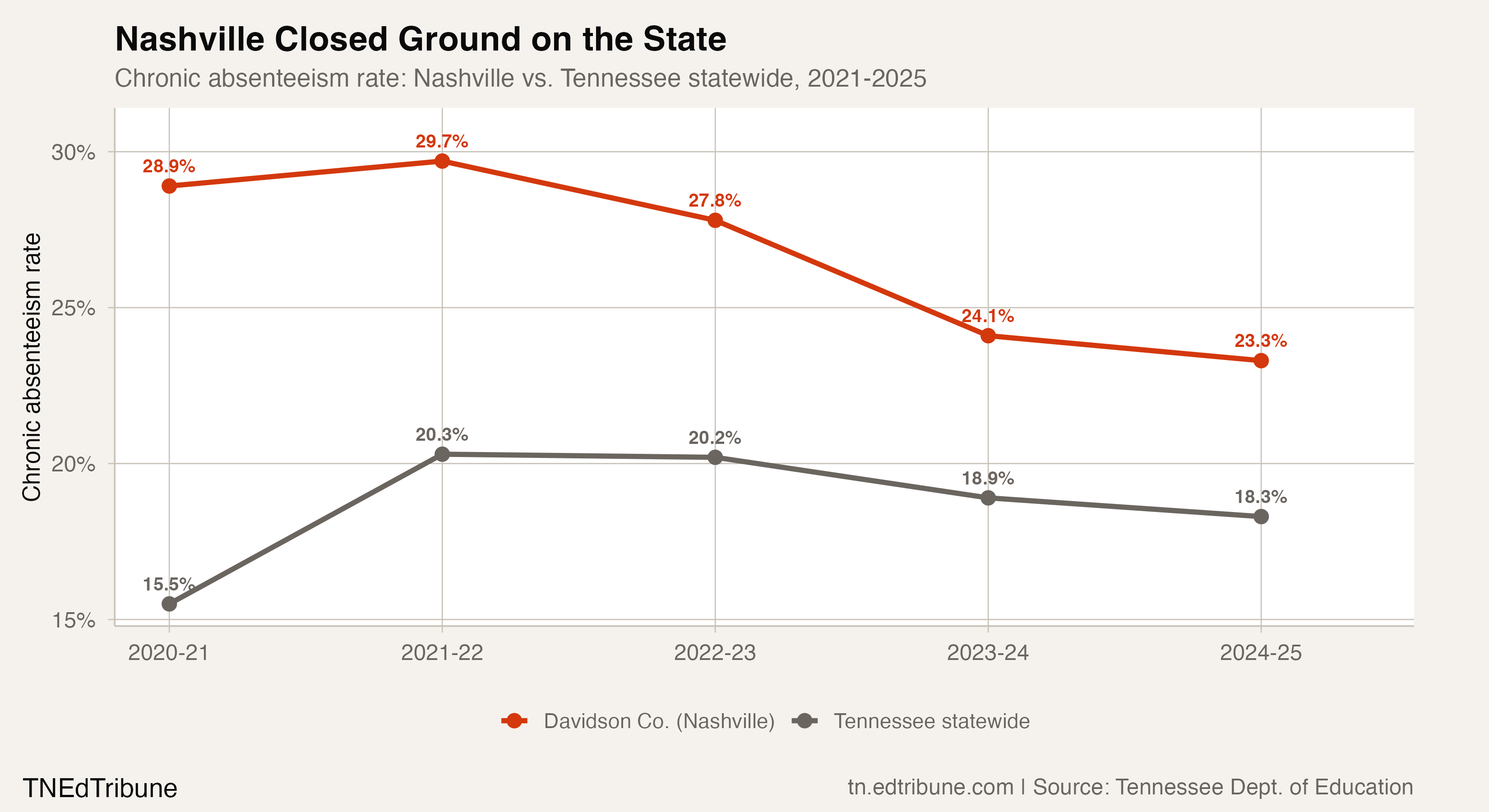
Nashville sat 13.4 points above the statewide chronic absenteeism rate in 2021. By 2025, that gap had narrowed to 5.0 points. But the pace of convergence slowed: Nashville gained 2.4 points on the state between 2023 and 2024, and only 0.2 points between 2024 and 2025.
TISA, the state funding formula that replaced the old BEP in 2023-24, distributes money using Average Daily Membership. Tennessee's TISA rules define that measure from the days a student is enrolled relative to the days school is in session, so daily absences do not directly reduce a district's membership or its funding. For a district with 77,490 students and a 23.3% chronic rate, the case for improving attendance rests on learning and legal accountability rather than a direct dollar penalty.
The question Nashville faces now is whether the tools that brought chronic absenteeism from 29% to 23% can push it below 20%. The K-8 improvements suggest the answer is yes for younger students. The high school reversal and the persistent poverty gap suggest that for the students who need the most support, the hardest work is still ahead.
Detailed code that reproduces the analysis and figures in this article is available exclusively to EdTribune subscribers.
Discussion
Sign in to join the discussion.
Loading comments...