Correction (July 21, 2026): An earlier version incorrectly said student absences reduce Average Daily Membership under Tennessee's funding formula. The state's TISA rules define that measure from days enrolled, not days attended.
The earlier version also described a 10.3-point K-8 Black-white gap as nearly five times a 0.6-point Hispanic-white gap; it is about 17 times as large. This version removes those errors and causal explanations the aggregate attendance data cannot test.
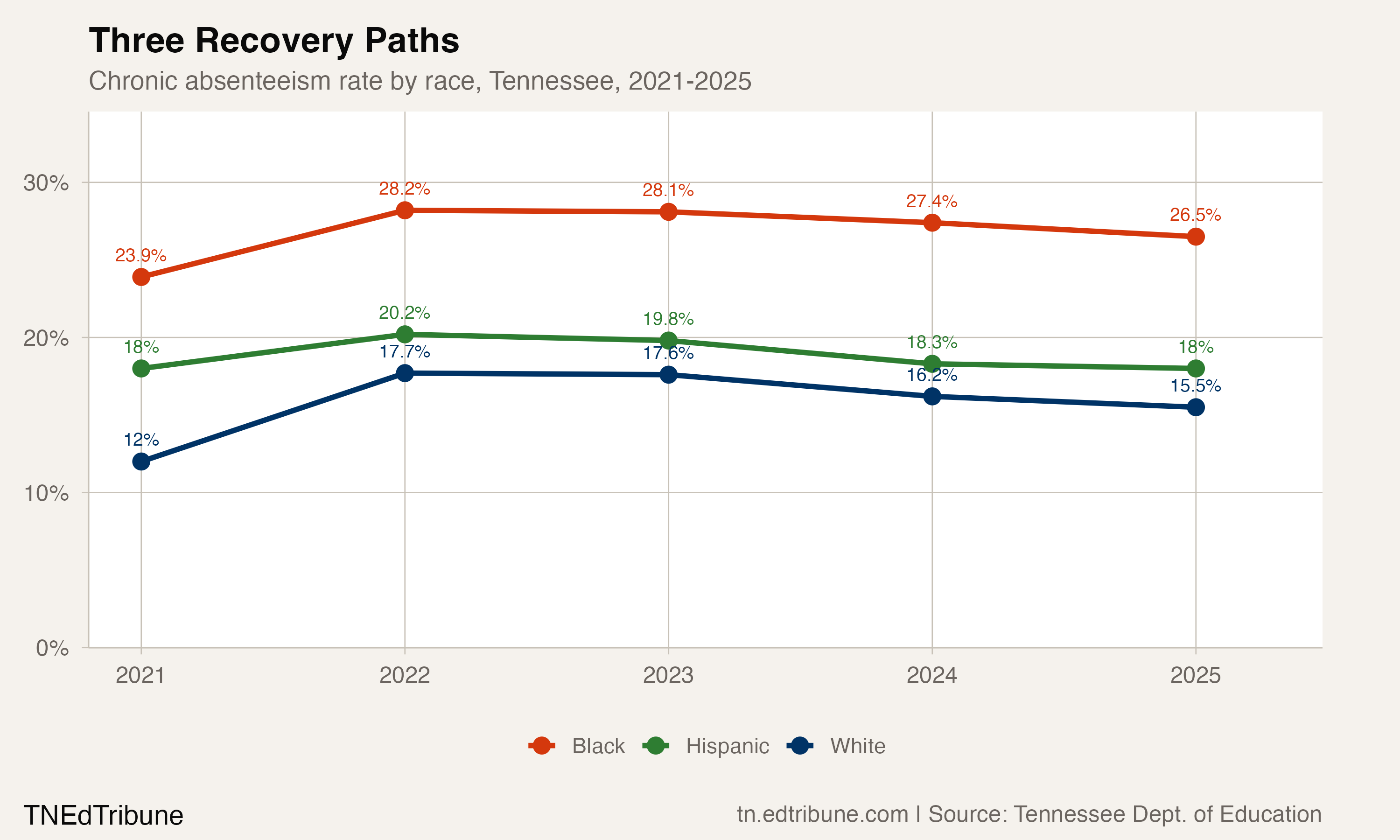
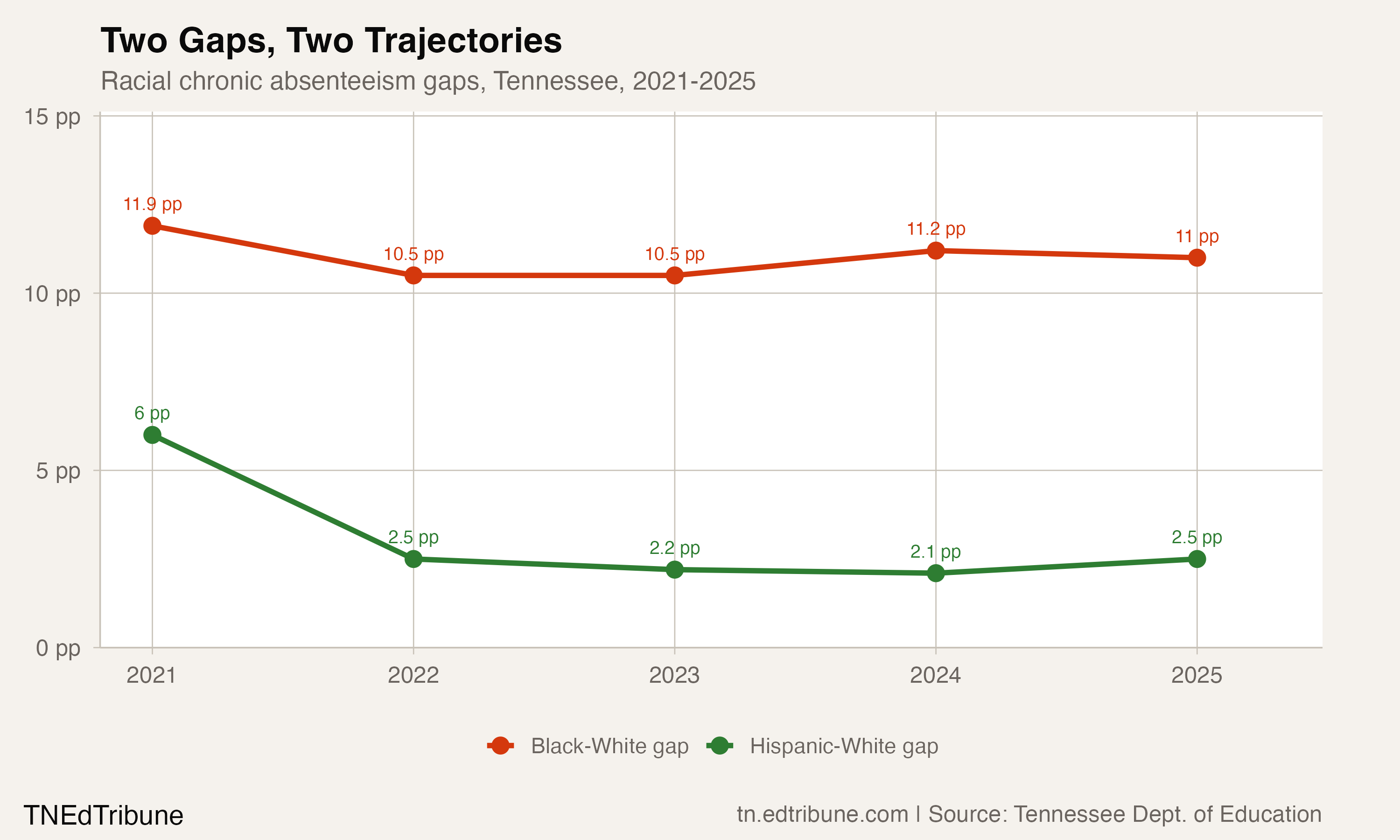
In 2021, Tennessee's Hispanic students were chronically absent at 18.0%, compared with 12.0% of white students, a 6.0-percentage-point gap. Four years later, the Hispanic rate was still 18.0%, while the white rate had risen to 15.5%. The gap therefore narrowed to 2.5 points, a reduction of 3.5 points, or 58%.
The arithmetic shows how the gap changed; it does not establish why either group's rate moved.
The Black-white gap changed much less. Black students' chronic absenteeism rate was 26.5% in 2025, 11.0 points above the white rate. The gap was 11.9 points in 2021, so its net reduction was 0.9 points.
Enrollment changed while the rate held steady
Tennessee's Hispanic enrollment grew from 121,889 students in 2021 to 158,876 in 2025. That was an increase of 36,987 students, or 30.3%, and lifted the group's share of statewide enrollment from 12.5% to 16.1%. White enrollment fell by 30,078 students over the same period.
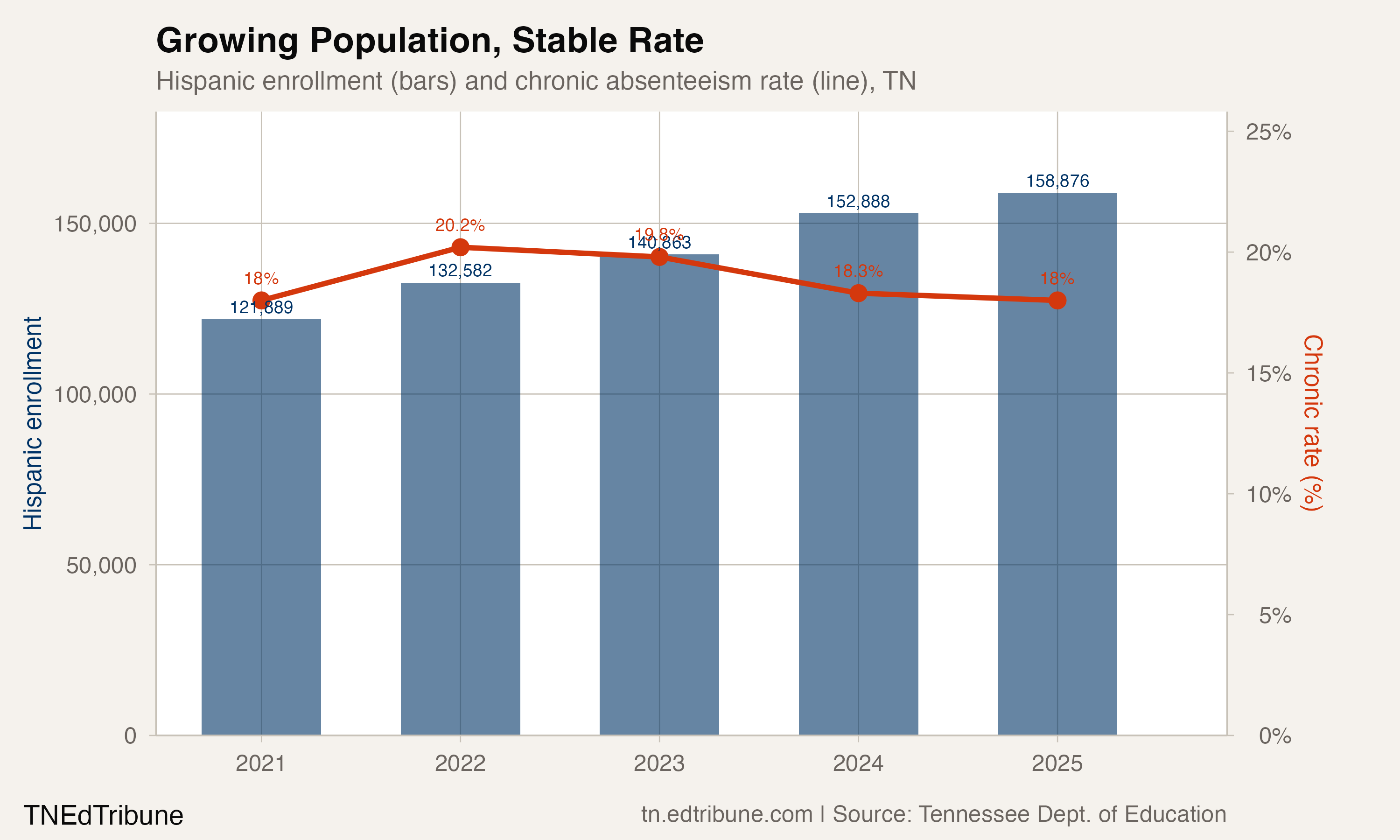
The statewide English-learner series moved in a different direction: enrollment rose from 77,351 to 107,105, while the chronic absenteeism rate fell from 18.8% to 16.3%, a 2.5-point decline. The published file reports Hispanic and English-learner totals separately; it does not provide the cross-tabulation needed to measure their overlap or determine whether enrollment composition caused either trend.
The K-8 gap reached near-parity
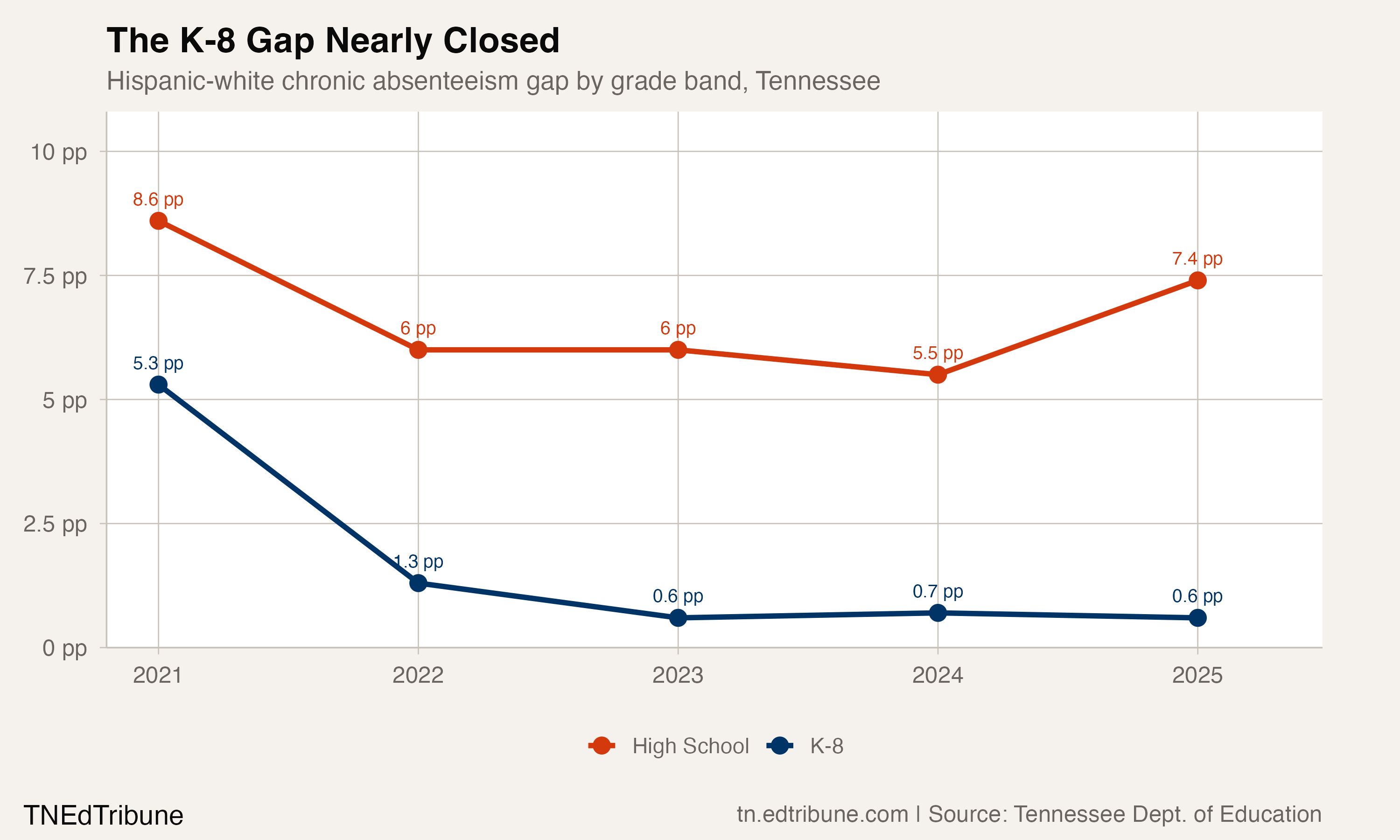
The statewide 2.5-point gap obscures a grade-level split. In grades K-8, the Hispanic-white gap shrank from 5.3 percentage points in 2021 to 0.6 points in 2025. Hispanic K-8 students were chronically absent at 14.2%, compared with 13.6% of white K-8 students.
At the high-school level, the gap narrowed from 8.6 points in 2021 to 5.5 points in 2024, then widened to 7.4 points in 2025. From 2024 to 2025, the Hispanic rate rose from 26.1% to 27.0%, while the white rate fell from 20.6% to 19.6%. More than one in four Hispanic high school students met the state's chronic-absence threshold in 2025.
Nashville drove the biggest shift
Among the 14 districts that enrolled at least 2,000 Hispanic students in 2025 and had complete comparison data, 11 narrowed the Hispanic-white gap and three widened it.
Davidson County recorded the largest narrowing: 9.3 percentage points between 2021 and 2025. In 2021, its Hispanic students were chronically absent at 32.7%, 16.0 points above white students. By 2025, the Hispanic rate was 22.8% and the gap was 6.7 points.
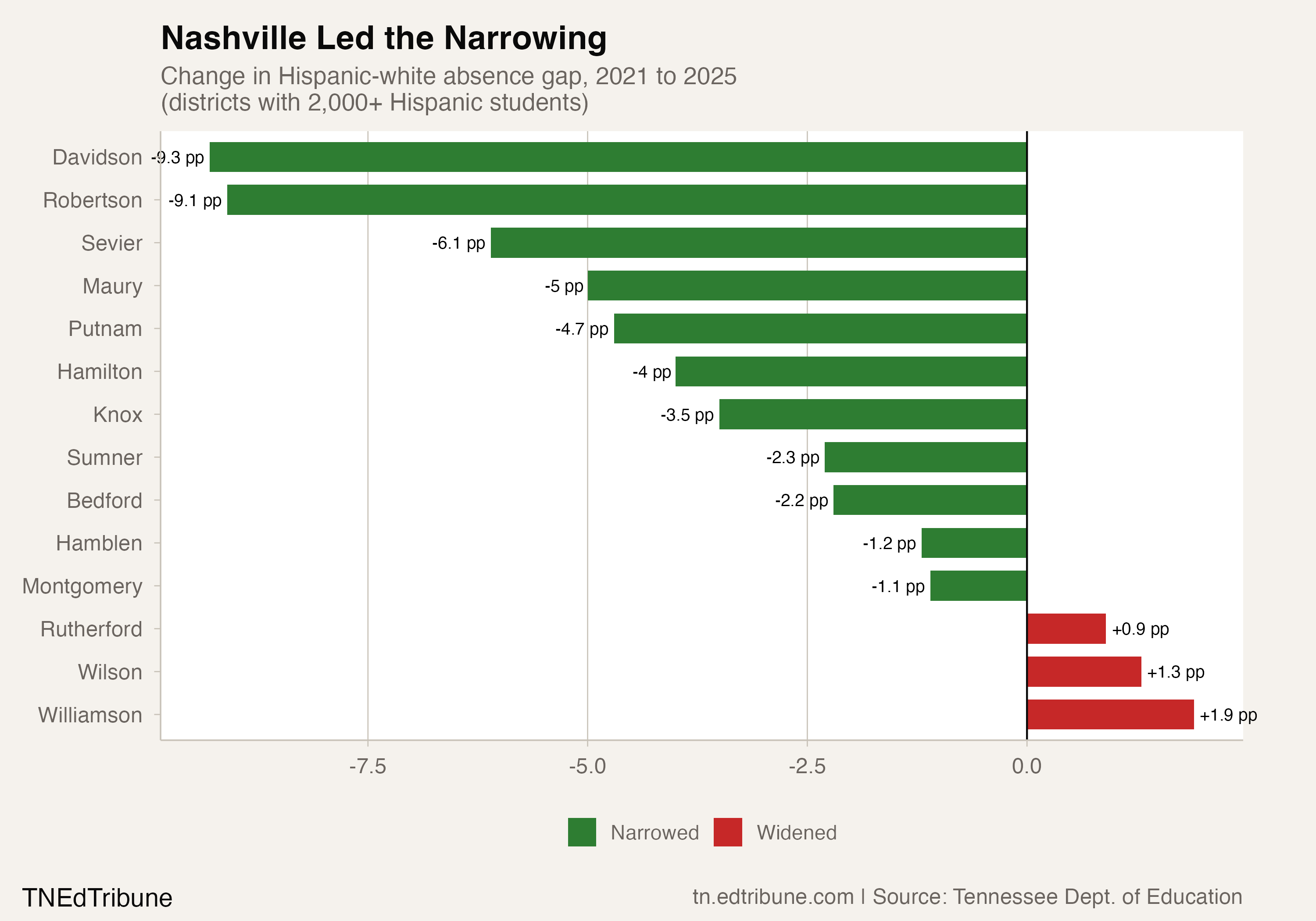
Robertson County recorded a 9.1-point narrowing. The pattern was not universal: Williamson County's gap widened by 1.9 points, and Rutherford County's widened by 0.9 points.
Hamblen County ran in the other direction. Its 2025 Hispanic chronic absenteeism rate was 11.4%, which was 5.3 points below its white rate of 16.7%. The district comparison identifies where rates diverged, but not the local causes.
The Black-white gap did not follow the same path
The gap between Black and white chronic absenteeism narrowed from 11.9 percentage points in 2021 to 10.5 in 2022, then measured 11.0 in 2025. Across those five years, it stayed within a 10.5-to-11.9-point range.
At the K-8 level, Black students' chronic absenteeism rate was 23.9% in 2025, 10.3 points above the white rate of 13.6%. That gap was down from 12.9 points in 2021, but it remained about 17 times the 2025 Hispanic-white K-8 gap of 0.6 points.
What the file can and cannot answer
Tennessee's TISA rules define Average Daily Membership from days a student is enrolled relative to the days school is in session. Daily absences do not directly reduce that membership measure.
The attendance file establishes that the statewide Hispanic-white gap narrowed by 58% while the rounded Hispanic rate was unchanged and the white rate rose by 3.5 points. It also establishes that the K-8 and high-school patterns diverged and that the Black-white gap remained within a narrow range. It does not identify student-level transitions or test whether demographic change, district programs, transportation, work obligations or any other mechanism caused those outcomes.
The next statewide release will show whether the Hispanic-white gap holds at 2.5 points and whether the K-8 and high-school paths move together again. Explaining why will require evidence beyond the aggregate rates reported here.
Detailed code that reproduces the analysis and figures in this article is available exclusively to EdTribune subscribers.
Discussion
Sign in to join the discussion.
Loading comments...