In Davidson County, the K-8 chronic absenteeism rate has fallen five years straight, from 25.2% down to 18.4%. Attendance teams in Nashville's elementary and middle schools have pushed nearly seven percentage points off the 2020-21 figure.
Walk across the hall to the high school wing and the story inverts. Davidson County's high school chronic absenteeism rate sits at 34.9%, up from 33.2% last year. More than one in three Nashville high schoolers missed at least 18 days of school.
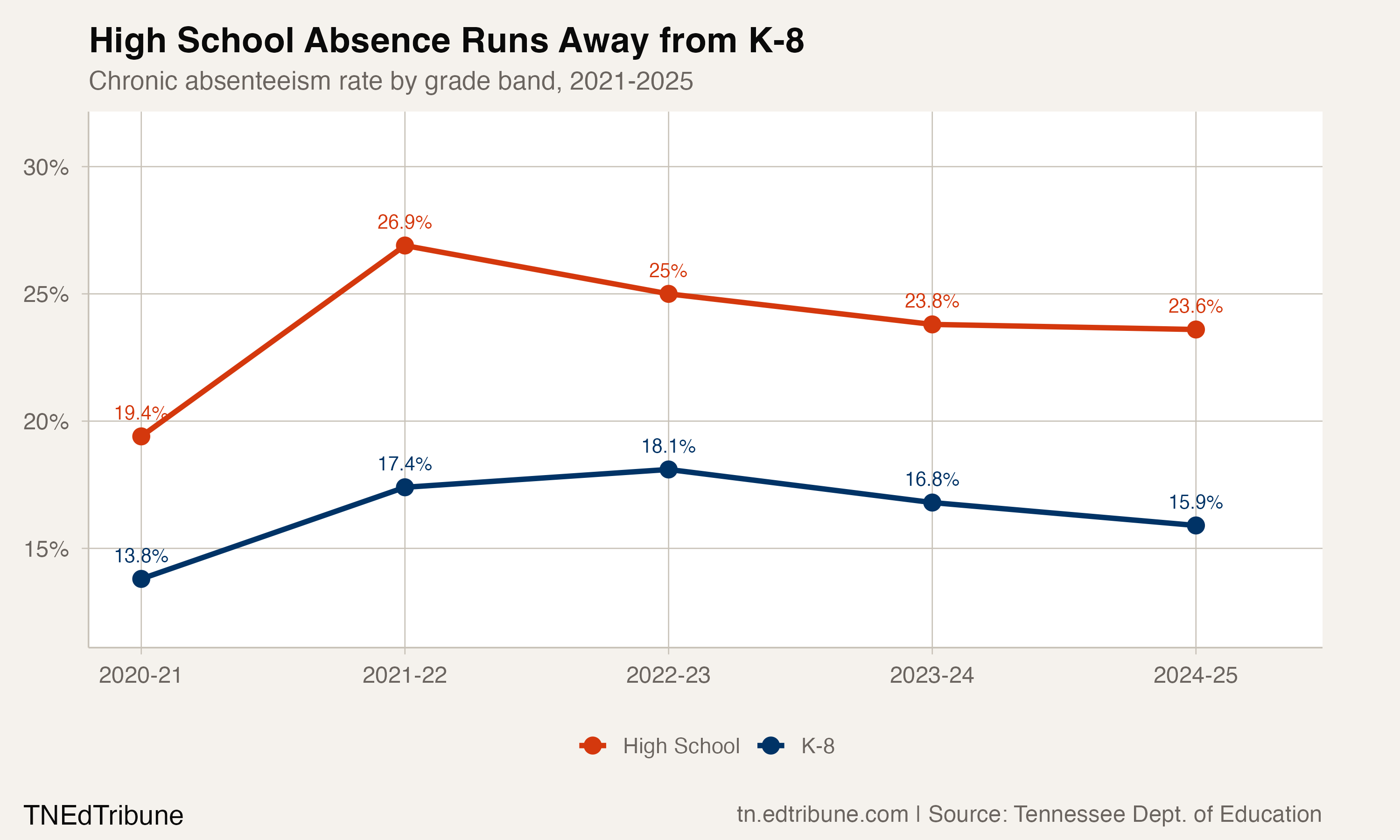
That split is not a Nashville anomaly. Statewide, 23.6% of Tennessee high schoolers were chronically absent in 2024-25, compared to 15.9% of K-8 students. The 7.7-percentage-point gap has widened from 5.6 points in 2020-21, and it grew again last year. K-8 schools are recovering from the pandemic attendance crisis. High schools are stuck.
The recovery that isn't
Both grade bands spiked after COVID. The trajectories since then have diverged.
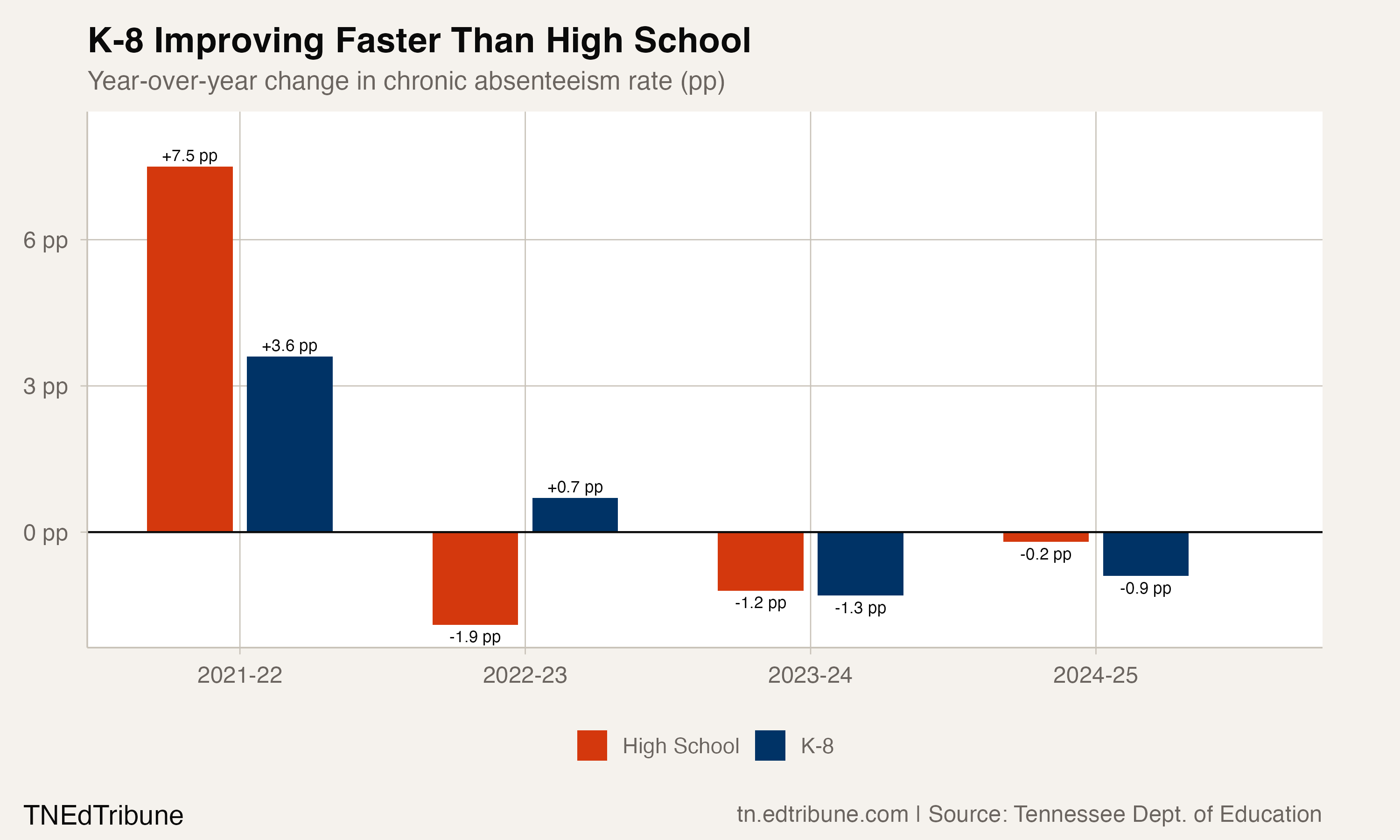
K-8 chronic absenteeism peaked at 18.1% in 2022-23, then dropped 1.3 points and 0.9 points in the next two years. That pace has brought K-8 schools more than halfway back toward the 2020-21 rate of 13.8%, itself already elevated above the pre-pandemic baseline of 13.1% the Tennessee Comptroller documented for 2018-19.
High schools peaked earlier, at 26.9% in 2021-22, but the descent has stalled. After dropping 1.9 points and 1.2 points in consecutive years, the rate fell just 0.2 points last year. At that pace, Tennessee's high school chronic absenteeism rate would not reach even 20% until the 2040s.
The raw numbers are large: 71,137 high schoolers were chronically absent in 2024-25, out of 301,949 enrolled. The K-8 count is higher in absolute terms (109,206 out of 684,738) because the population is larger, but the rate is the relevant comparison. A K-8 student has roughly a one-in-six chance of chronic absence. A high schooler has nearly one in four.
Where the chasm opens widest
The 7.7-point statewide gap is an average. For some student groups, the high school penalty is far steeper.
English learners face the most extreme split: 12.5% chronic absenteeism in K-8, 30.2% in high school, a 17.7-point gap. That jump suggests something structural happens to EL students' attendance at the high school transition. Hispanic students show a similar pattern, with the gap at 12.8 points (14.2% K-8 vs. 27.0% HS). Many Hispanic high schoolers in Tennessee are English learners, so these categories overlap substantially, but the size of both gaps points toward barriers that compound in the upper grades.
Economically disadvantaged high schoolers are chronically absent at 38.0%, compared to 27.1% for their K-8 peers. That 10.9-point gap means the high school transition adds roughly 11 percentage points of chronic absence risk for low-income students. Black high schoolers face a similar penalty: 23.9% in K-8, 32.5% in high school, an 8.6-point gap.
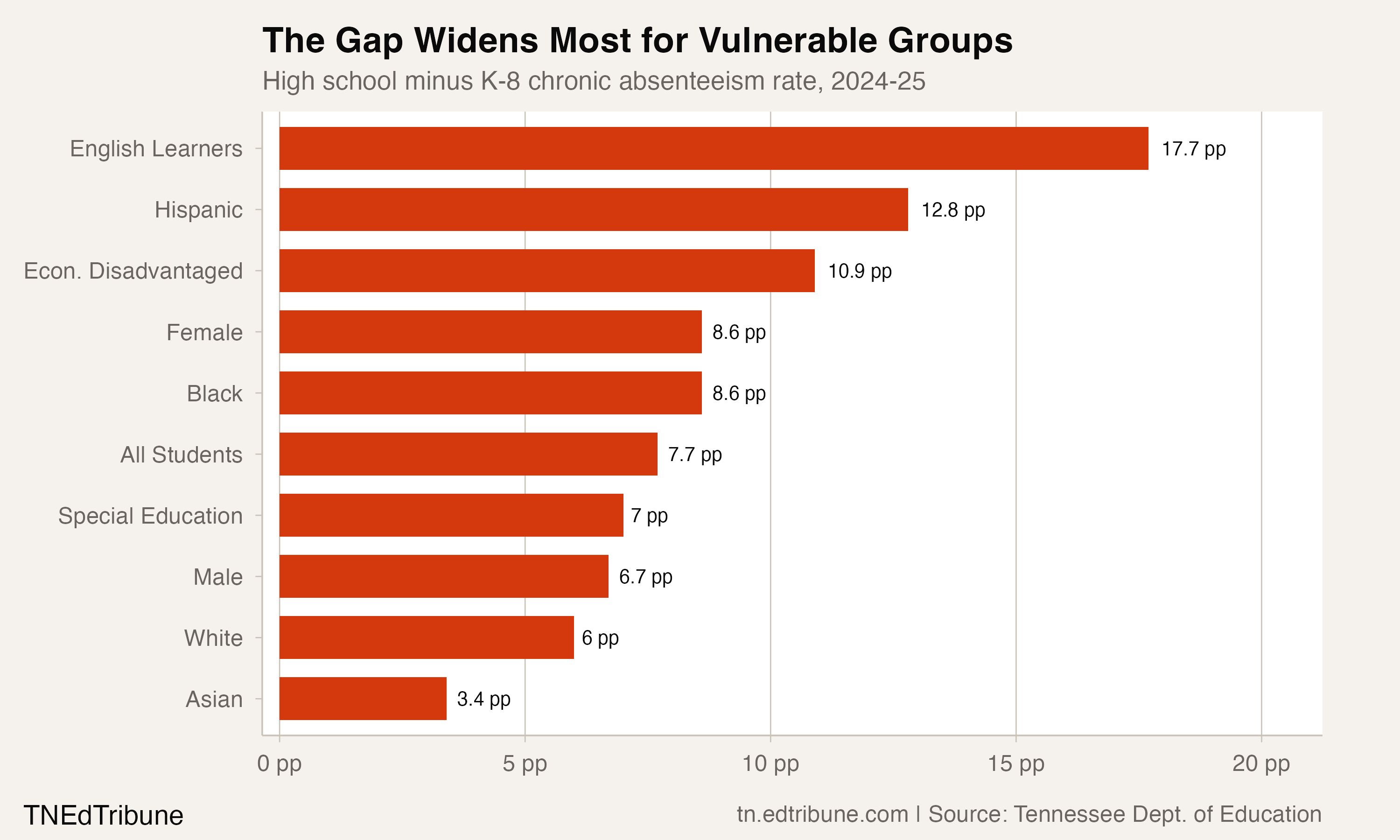
The gap is smallest for Asian students (3.4 points) and white students (6.0 points), who start from lower K-8 baselines and see smaller increases in high school. The pattern is consistent: the groups already struggling most with attendance in K-8 see the sharpest deterioration in high school.
Memphis and Nashville: same problem, opposite directions
Memphis-Shelby County Schools, the state's largest district, illustrates how the high school problem can worsen even while K-8 improves. The district's K-8 rate fell from 28.0% to 26.9% last year. Its high school rate rose from 33.5% to 38.4%, the highest among major districts and a climb of nearly 20 points from the 2020-21 rate of 18.7%.
Nearly 12,000 Memphis-Shelby County↗ET high schoolers were chronically absent last year. Midyear data from February 2026 showed nearly 40% of high schoolers on track for chronic absenteeism in 2025-26. Schools designated for Comprehensive Support and Improvement were running above 40%.
Nashville's story is the reverse trajectory: dramatic K-8 improvement alongside stubborn high school rates. Davidson County cut its K-8 rate from 25.2% to 18.4% over five years, a 6.8-point decline. But the high school rate, which peaked at 41.5% in 2021-22, has been volatile, landing at 34.9% this year after dropping to 33.2% the prior year. The 16.5-point gap between Davidson County's high school and K-8 rates is the third-largest among districts with at least 2,000 students, trailing only Haywood County (19.3 points) and Lauderdale County (18.4 points).
Why high school is different
The mechanisms behind the grade-level gap are not mysterious, even if they are hard to address.
Tennessee's three-tier truancy intervention system triggers at five unexcused absences, but the framework treats all grades the same. A first-grader missing five days will almost certainly have a parent at the required attendance conference. A 17-year-old with a car, a part-time job, and a parent working two shifts faces a fundamentally different set of pressures. Tennessee does not require work permits for minors, and state law exempts 16- and 17-year-olds from several child labor restrictions when they have parental consent.
Mental health is another compounding factor. In 2021, 29% of Tennessee high school students reported experiencing poor mental health in the past month, while over 40% had symptoms of depression in the prior year, according to a Sycamore Institute analysis. Adolescents are more likely than younger children to experience school avoidance related to anxiety, and the pandemic appears to have deepened these patterns.
Tennessee Department of Education data shows that students chronically absent in ninth grade are 30 percentage points less likely to earn an on-time diploma: a 62% graduation rate compared to 92% for their peers. The Comptroller's Office has separately found that chronic absence rates climb from freshman to senior year, with roughly 25% of seniors chronically absent compared to 15% of freshmen. The high school chronic absenteeism problem compounds: students who disengage in ninth grade are less likely to re-engage, and their absence worsens as they age through the system.
A funding formula that notices
The Tennessee Investment in Student Achievement (TISA) formula, which replaced the Basic Education Program in 2023-24, allocates funding on a per-student basis with weighted adjustments for student characteristics. Districts with high concentrations of economically disadvantaged or English learner students receive additional funding, but only for students who are enrolled. The formula does not directly penalize absence, but chronic absence functionally reduces the instructional return on every dollar spent.
For a district like Memphis-Shelby County, where 38.4% of high schoolers and 26.9% of K-8 students are chronically absent, the question is not just whether the money arrives but whether the students do.
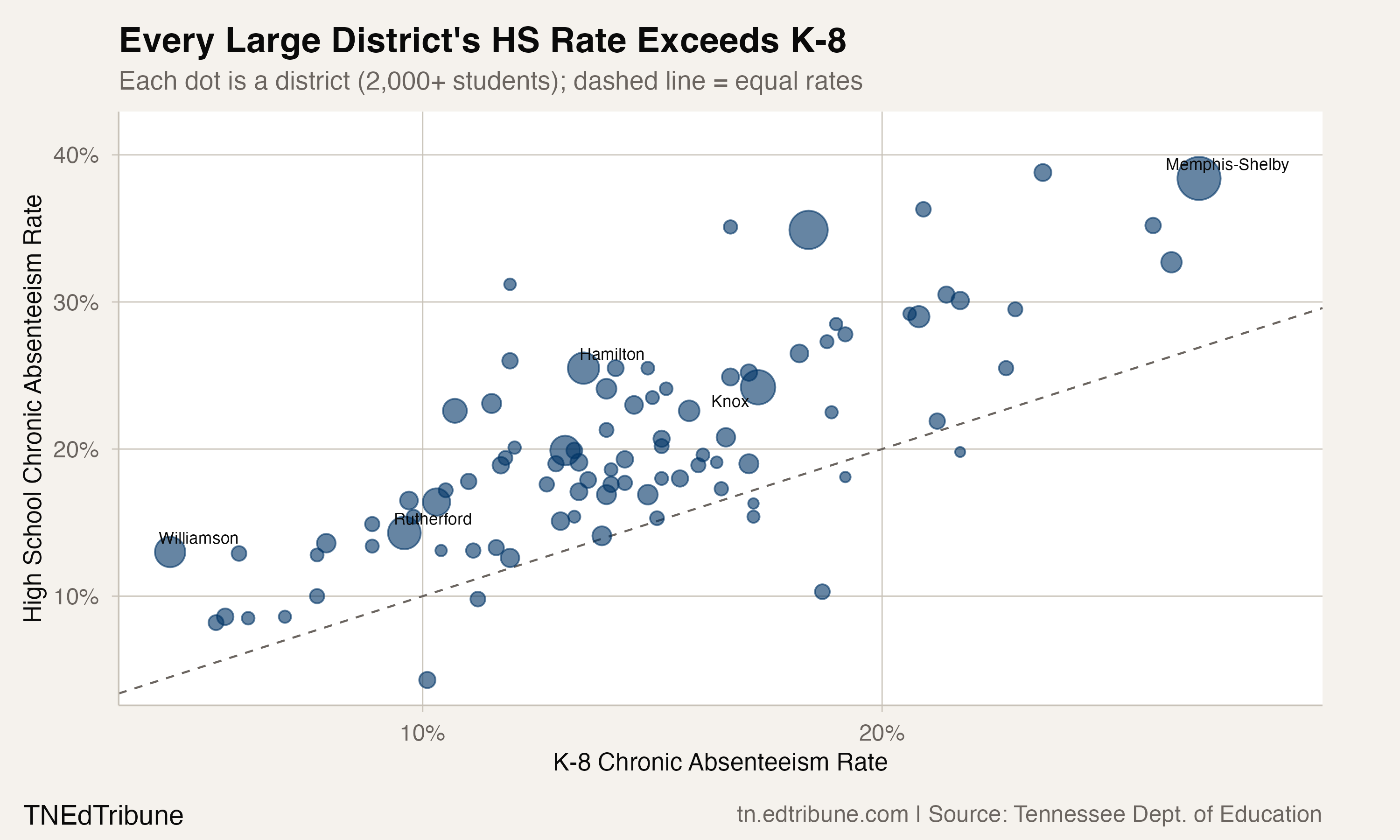
The scatter plot of Tennessee's large districts tells a nearly uniform story: the vast majority sit above the diagonal line where high school and K-8 rates would be equal. Only a handful of smaller districts buck the pattern. Williamson County, one of the state's most affluent districts, has a K-8 rate of just 4.5% but a high school rate of 13.0%, nearly triple. The gap is structural, not confined to high-poverty districts.
The income amplifier
The starkest version of the grade-level gap appears among economically disadvantaged students.
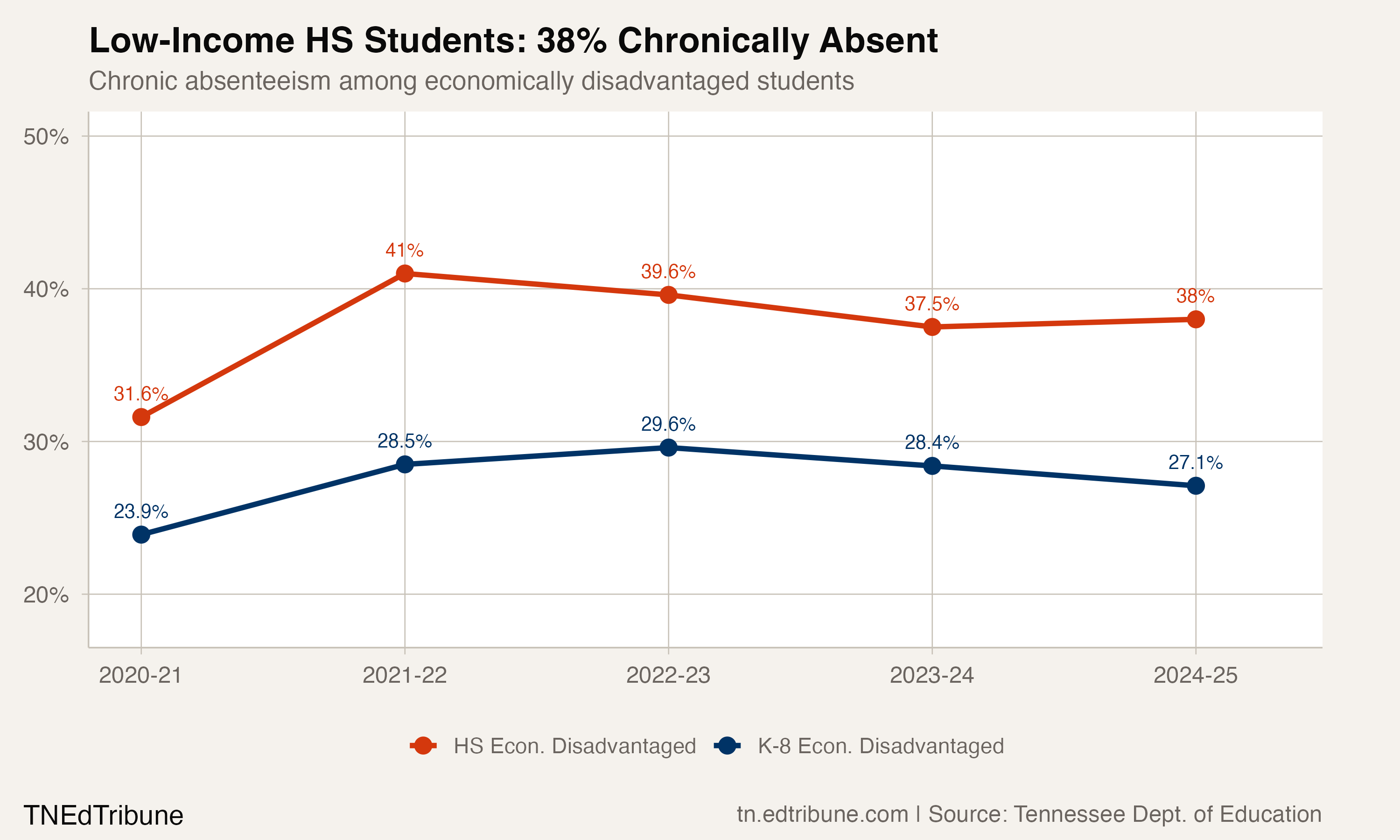
In 2020-21, economically disadvantaged K-8 students had a chronic absenteeism rate of 23.9%. Their high school peers were at 31.6%, a 7.7-point gap. By 2024-25, the K-8 rate had risen to 27.1% (a 3.2-point increase) while the high school rate climbed to 38.0% (a 6.4-point increase). The gap between low-income K-8 and low-income high school students expanded from 7.7 to 10.9 points.
Put differently: more than one in three economically disadvantaged high schoolers in Tennessee is chronically absent.
Tennessee ranks third nationally in post-COVID math recovery, evidence that the state's schools can close pandemic-era gaps when the system pushes. Attendance has not responded with the same urgency. In K-8, the trajectory is encouraging. In high school, one in three economically disadvantaged students is chronically absent, the rate reversed course last year, and no major district has cracked the code. The gap between grade levels is not closing. It is widening.
Detailed code that reproduces the analysis and figures in this article is available exclusively to EdTribune subscribers.
Discussion
Sign in to join the discussion.
Loading comments...