Correction (July 21, 2026): An earlier version incorrectly said some qualifying districts' Hispanic graduation rates were below Tennessee's statewide foster-care rate. The lowest qualifying district rate was 73.2 percent, while the foster-care subgroup rate was 56.9 percent. The district comparison and cohort terminology have been corrected.
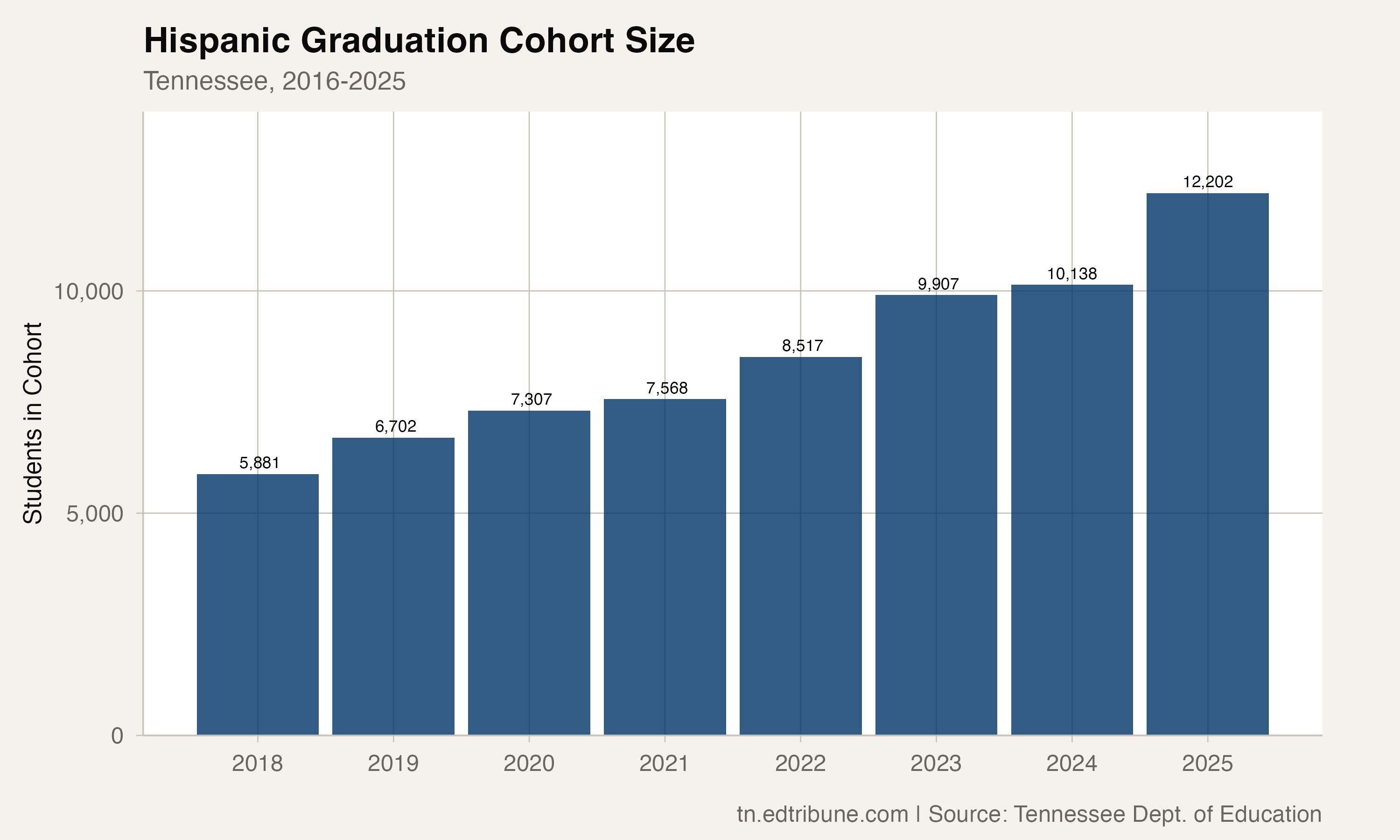
Tennessee's Hispanic graduation cohort has more than doubled since 2018, growing from 5,881 students to 12,202 in 2025. Hispanic students now make up 16.3% of the state's graduating class, up from 8.1%.
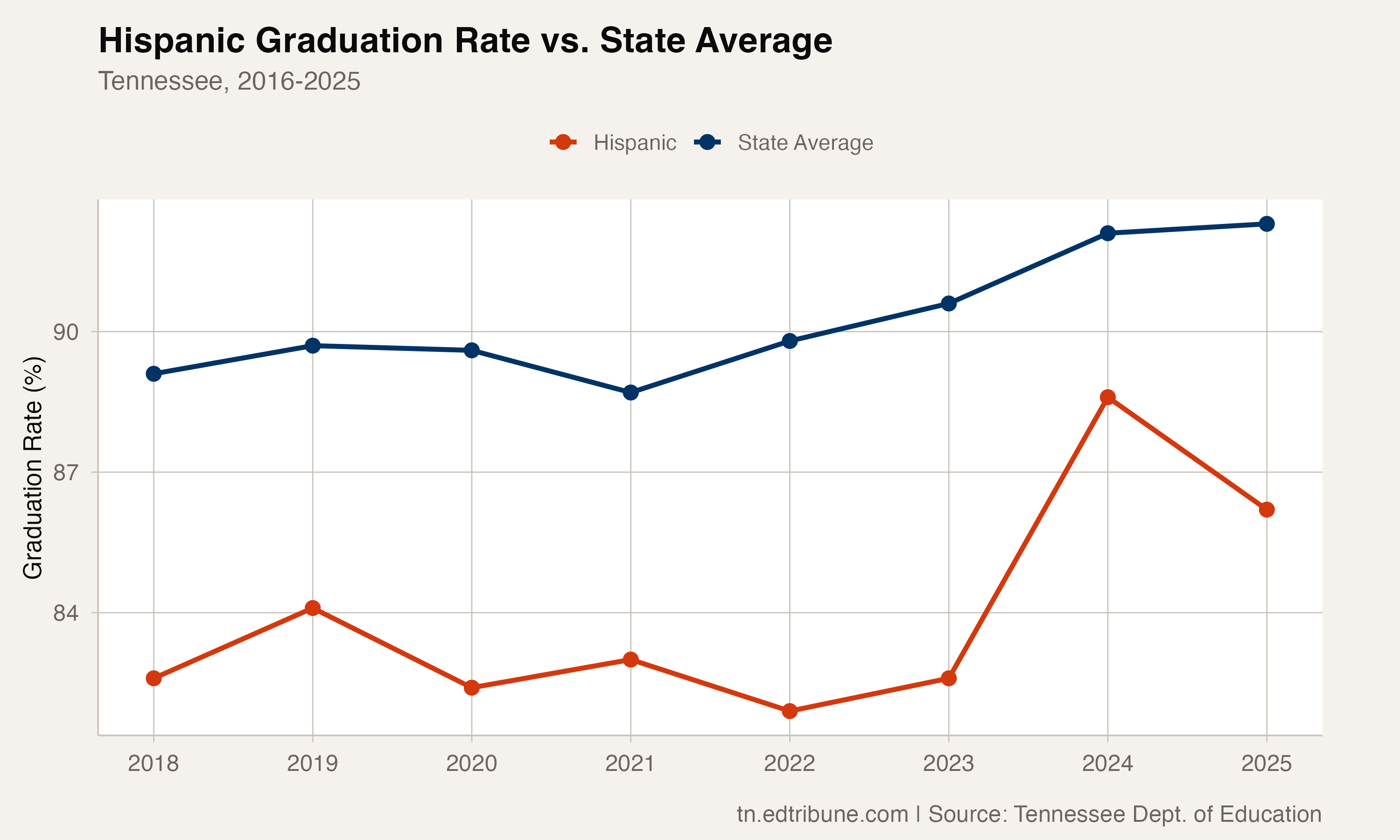
The graduation rate has improved, but not enough to erase the gap. Hispanic students graduated at 86.2% in 2025, compared with the statewide rate of 92.3%. The white-Hispanic gap stood at 8.9 percentage points.
The long-run story is not simple decline. The Hispanic rate is higher than it was in 2018.
The Hispanic rate was 88.6% in 2024.
The Hispanic rate fell to 86.2% in 2025. Among the five major racial groups reported statewide that year, Hispanic students had the lowest rate.
The gap that refuses to close
The white-Hispanic gap was 9.7 points in 2018. It narrowed and widened across the next several cohorts, reaching 11.3 points in 2023, falling to 5.9 points in 2024, and rebounding to 8.9 points in 2025.
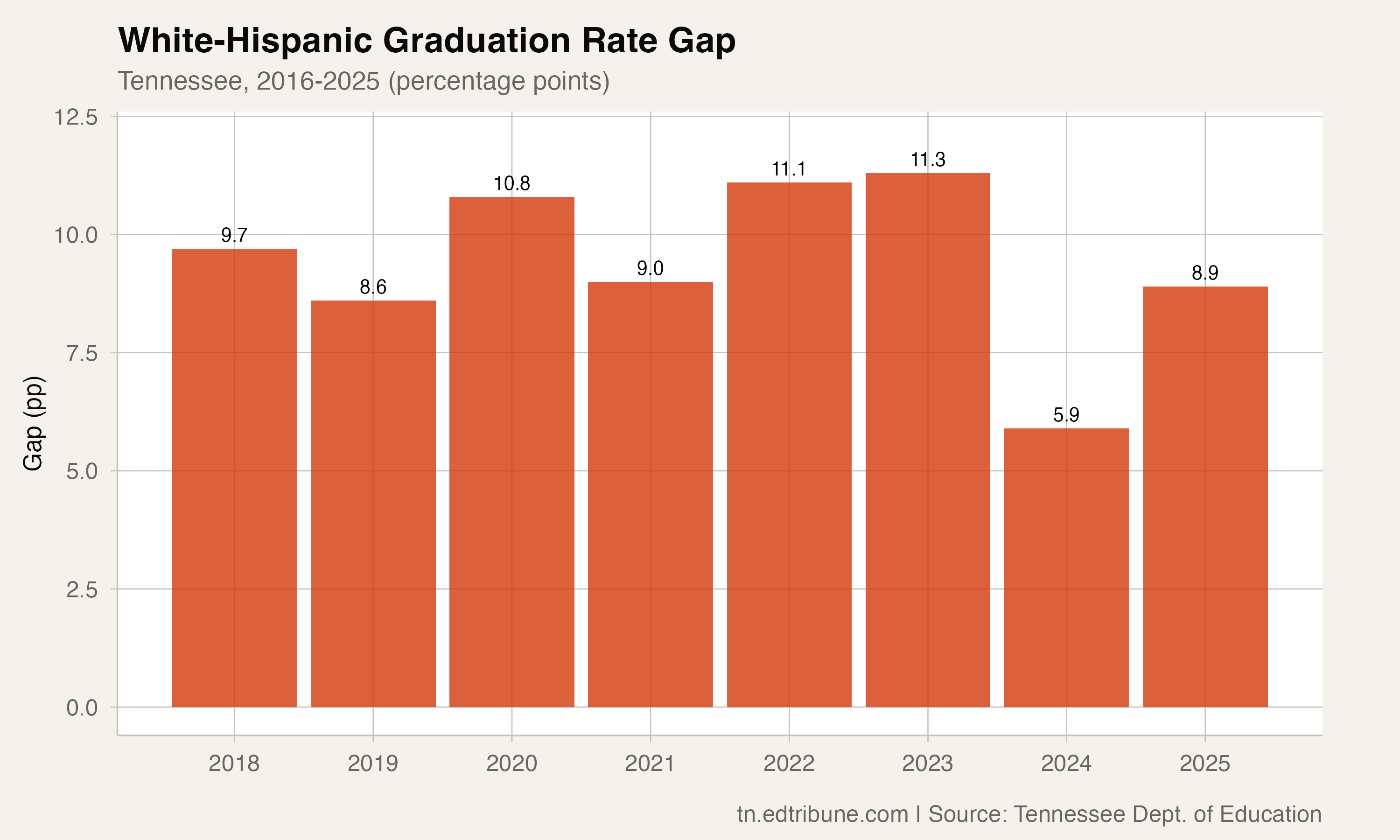
That whiplash matters because the Hispanic cohort is growing quickly. A sharp one-year improvement in 2024 — when Hispanic rates jumped to 88.6% — briefly narrowed the gap to 5.9 points.
In 2025, the Hispanic rate dropped back to 86.2%.
The pattern is not a steady climb. It is a larger cohort moving through a graduation rate that still swings from year to year.
Nashville is the epicenter
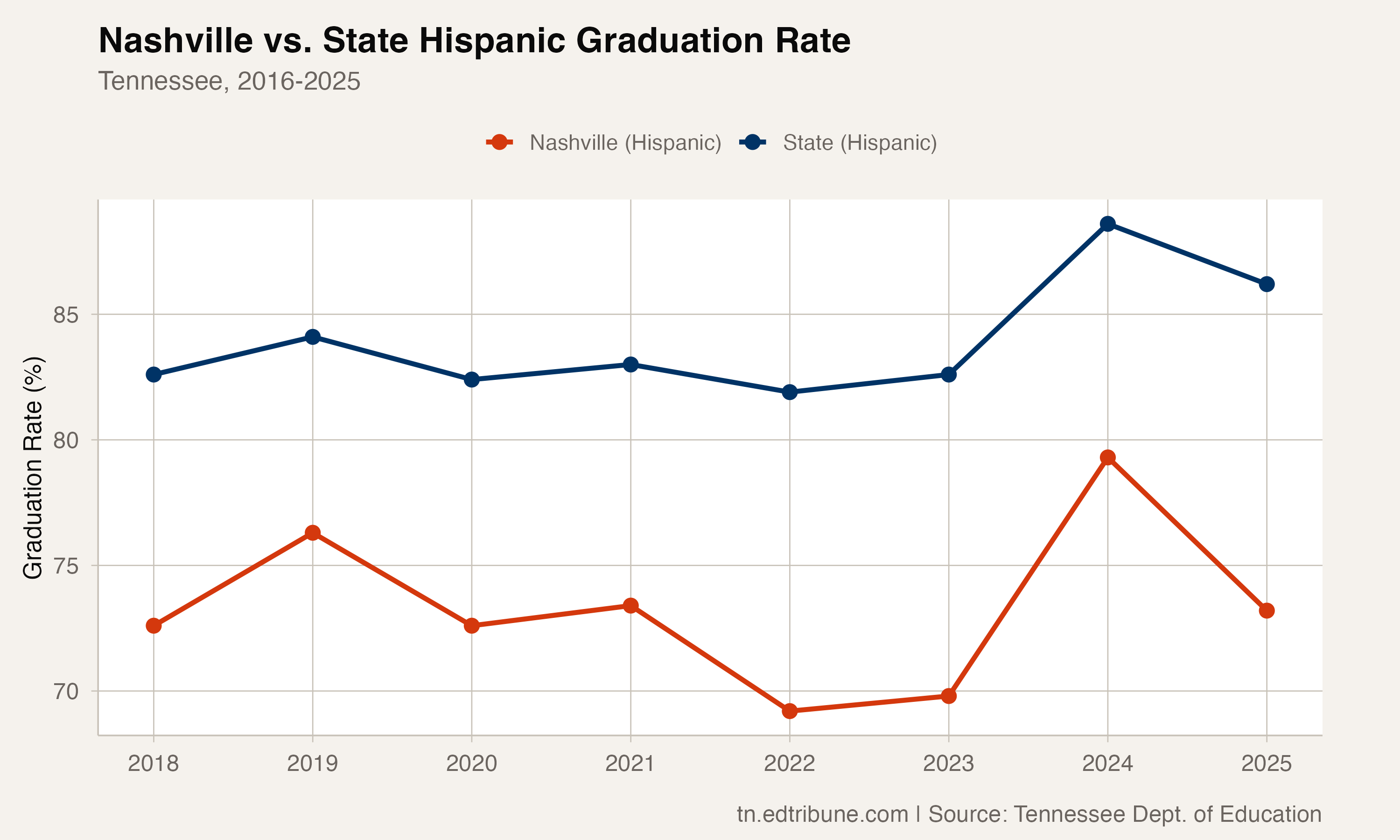
Davidson County — Nashville — is home to 2,471 Hispanic students in the graduation cohort, roughly one in five students in Tennessee's statewide Hispanic cohort. Nashville's Hispanic graduation rate fell to 73.2% in 2025.
In 2024, Nashville's Hispanic rate was 79.3%.
The statewide Hispanic rate in 2025 was 86.2%.
Nashville's Hispanic rate has been persistently lower than the state's, hovering in the low-to-mid 70s for most of the decade.
Nashville's Hispanic jump to 79.3% in 2024 looked like a turning point. It was not.
The 2025 cohort grew by 538 students — a 28% surge in a single year. The graduation data does not say whether those students were newly arrived families, students aging into high school from Nashville's K-8 population, transfers from other districts, or some combination of those factors.
Wide district variation
Among districts with at least 100 Hispanic graduates, the spread is wide. Putnam County graduates 98.3% of its 173 Hispanic students. Montgomery County reaches 96.4% with 466 students. Sumner County, Wilson County, and Williamson County all exceed 94%.
At the other end, Nashville's 73.2% and Memphis-Shelby County's 78.1% serve cohorts of 2,471 and 1,640 respectively — together, about a third of all Hispanic graduates statewide.
Among the 18 districts with at least 100 Hispanic graduates, the gap between highest (Putnam County, 98.3%) and lowest (Nashville, 73.2%) is 25.1 percentage points. Hispanic students in some Tennessee districts are graduating at rates comparable to white students statewide, but the package does not identify why district outcomes differ so widely.
The cohort that matters more every year
When Tennessee's Hispanic graduation cohort was 5,881 students, the gap touched fewer families. At 12,202 students — and growing — the same gap now touches communities across the state.
The math is straightforward: if Hispanic students graduated at the state average of 92.3% instead of 86.2%, the 2025 cohort size implies approximately 744 additional diplomas. If that rate gap stayed constant, the counterfactual number would grow with the cohort.
The 2024 jump showed that the gap can narrow quickly. The following year's reversal showed that one strong cohort is not the same as a trend.
Detailed code that reproduces the analysis and figures in this article is available exclusively to EdTribune subscribers.
Discussion
Sign in to join the discussion.
Loading comments...