Tennessee set a graduation rate record in 2025, lifting the statewide rate to 92.3%. Behind that number, 898 of the 1,577 students in foster care in the class of 2025 earned a diploma, a rate of 56.9%. That is 35.4 percentage points below the state average, the widest gap of any subgroup Tennessee reports.
No other subgroup is close. Students receiving special education services graduated at 84.2%, a gap to the state average that has narrowed from 17.9 points in 2015 to 8.1 points in 2025, and they finish 27.3 points ahead of students in foster care. Students who are currently homeless in Tennessee, who face many of the same instabilities, graduated at 82.0%, or 25.1 points higher than students in state custody.
A trajectory that is improving, but slowly
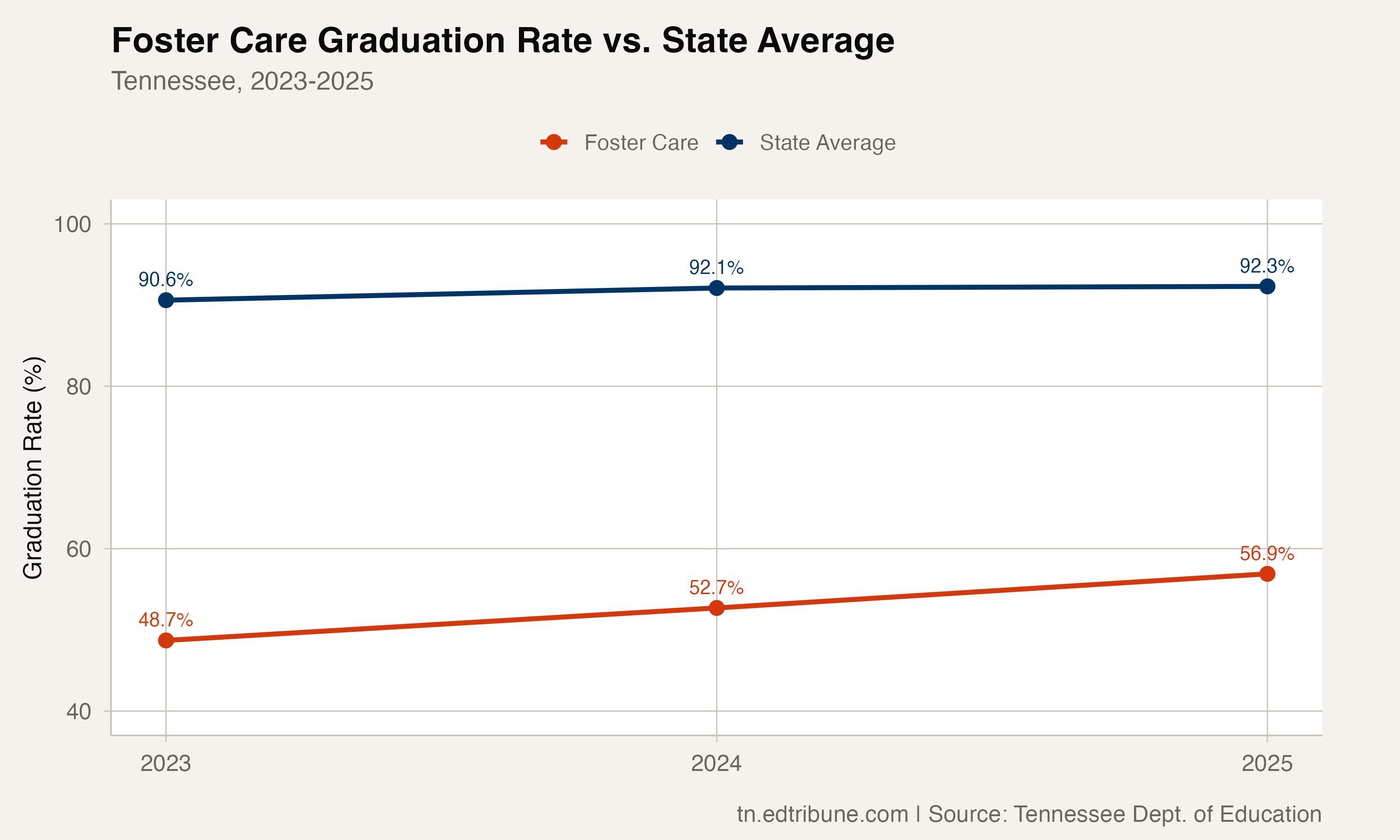
The foster care subgroup first appears in Tennessee's published graduation file in 2023, so there are only three years of trendline. What those three years show is improvement: from 48.7% to 52.7% to 56.9%, a gain of 8.2 percentage points. The direction is encouraging. The distance remaining is not.
At that pace of roughly 4.1 points a year, students in foster care would not reach the state's current 92.3% until the mid-2030s. The state average is also still rising, by 1.7 points across the same three years, so the gap is closing more slowly than the foster care rate alone suggests.
The DCS Education Division
The Department of Children's Services Education Division, which provides education services for students in state custody, reported a graduation rate of 26.0% for its cohort of 484 students in 2025. That is the lowest published rate of any school district in Tennessee, below the Achievement School District's 40.9%.
The DCS division has improved, rising from 15.6% in 2023 to 26.0% in 2025. Even doubling that rate would leave it at 52%.
Not all students in foster care are served by the DCS division. Of the 1,577 in the class of 2025, 483 were counted at DCS, roughly a third of the total. The other 1,094 were enrolled elsewhere in the state, and 772 of them graduated, a rate of 70.6%. That is 44.5 points above the DCS figure for students in foster care and still 21.7 points below the state average.
The anatomy of a 35-point gap
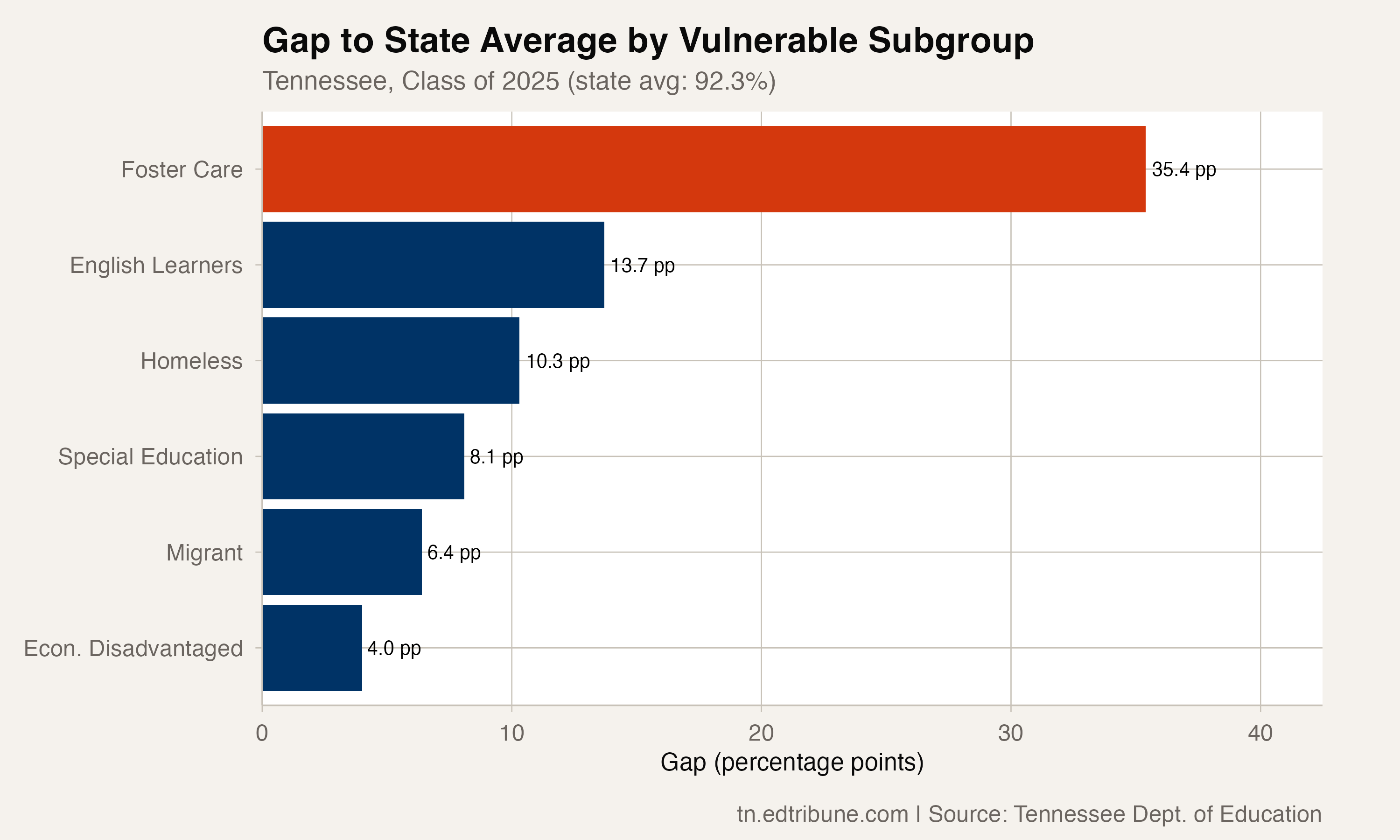
Tennessee's published file records the outcome, not the cause. What it does establish is how far the foster care result sits from every other group the state tracks for comparable reasons of instability:
- Students in foster care: 56.9% (gap of 35.4 pp, cohort of 1,577)
- Students who are English learners: 78.6% (gap of 13.7 pp)
- Students who are currently homeless: 82.0% (gap of 10.3 pp)
- Students receiving special education services: 84.2% (gap of 8.1 pp)
- Students identified as migrant: 85.9% (gap of 6.4 pp, cohort of 64)
- Students who are economically disadvantaged: 88.3% (gap of 4.0 pp)
The 1,577 students in foster care are 2.1% of the 74,865-student class of 2025. That is small enough for the statewide rate to absorb the shortfall without registering a visible change.
The scale of the challenge
What makes the 2025 figures notable is the combination: a record statewide rate of 92.3% in the same year that the foster care rate stood at 56.9%.
When a state graduates 92.3% of its students, a group finishing at 56.9% is not evidence of a broad systemic failure. It is a specific group, and the published data is precise enough to name it.
The 679 students in foster care who did not earn a diploma with the class of 2025, the difference between the 1,577-student cohort and the 898 who graduated, are countable. Where they went, and which supports might have kept them on track, is a question the graduation rate can pose but not answer.
Data source: Tennessee graduation rate data comes from the Tennessee Department of Education. Foster care subgroup data is available from the 2022-23 cohort onward. All rates are 4-year adjusted cohort graduation rates. Most districts' foster care results are suppressed for small cohort size, so the figures here are taken from the published statewide and DCS Education Division rows rather than summed across districts.
Detailed code that reproduces the analysis and figures in this article is available exclusively to EdTribune subscribers.
Discussion
Sign in to join the discussion.
Loading comments...