Female students in Tennessee have graduated at higher rates than male students for as long as the state has tracked gender data. But the gap has been shrinking. In 2018, the first year gender-specific data is available, females led males by a sizable gap. By 2025, that gap had narrowed to 3.3 points, the smallest since the state began publishing gender data.
The closing is a story about male improvement. Male graduation rates climbed from 86.3% to 90.7%, a gain of 4.4 points. Female rates improved too, from 92.0% to 94.0%, but at roughly half the pace. Males have been closing the gap by improving faster, not because female outcomes have declined.
Seven years of convergence
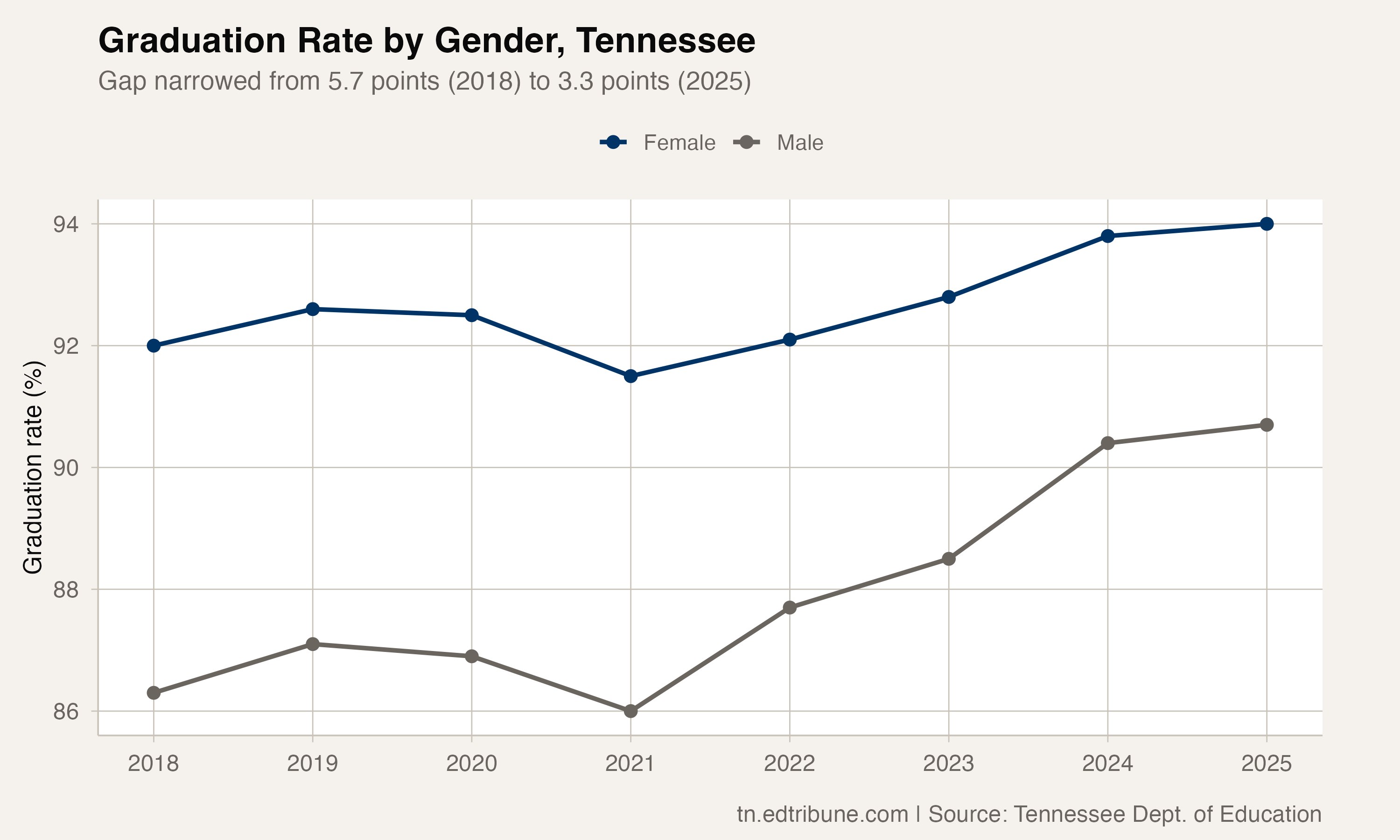
The gender gap has narrowed in six of the seven year-over-year transitions since 2018. The only exception was 2019 to 2020, when the gap widened by a tenth of a point, from 5.5 to 5.6. The consistency of the trend is notable. This is not a single-year jump but a sustained, gradual convergence.
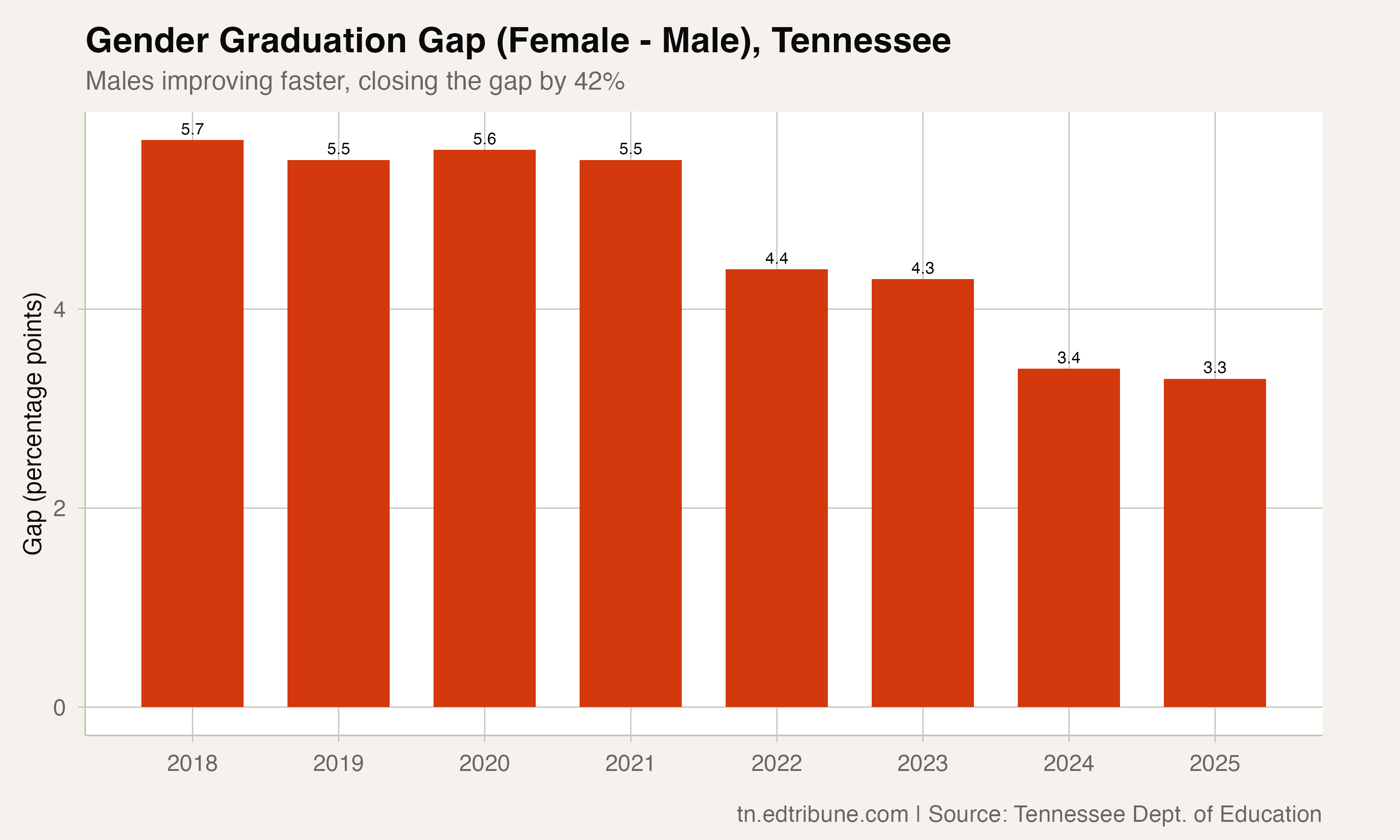
The narrowing has not been evenly paced. The steepest single-year move came between 2021 and 2022; the second steepest came between 2023 and 2024. The other four narrowing years moved the gap by 0.1 or 0.2 points each.
The scale of the male cohort
Tennessee's male graduation cohort is consistently larger than the female cohort, 38,434 males versus 36,431 females in 2025. The male cohort has been the larger of the two in every year gender data has been published, by between 1,492 and 2,795 students.
Of the 38,434 males in the class of 2025, 34,865 graduated on time, leaving 3,569 who did not. Had that cohort graduated at the female rate of 94.0%, about 2,306 would not have, roughly 1,263 fewer. The gap in percentage terms is 3.3 points, but in human terms it represents more than a thousand additional young men leaving high school without a diploma.
What the gap measures and what it does not
Graduation rate data captures one outcome: whether a student received a diploma within four years. It does not capture the quality of that diploma, post-graduation outcomes, college enrollment, or career readiness. A narrowing gap in diplomas awarded is not evidence that gaps after high school are narrowing with it.
The gender gap in graduation rates also interacts with other categories in ways that aggregate data obscures. Tennessee publishes graduation rates by gender and separately by race, but not by the two together, so the state's public files cannot show whether the gender gap runs wider or narrower among Black, Hispanic, white or Asian students. Reporting the gender gap as 3.3 points treats all males as a single group, which simplifies a more complex reality.
The trajectory question
The gap has closed at an average of roughly 0.3 points a year since 2018. If that average held, it would take about a decade to erase what remains. Whether that trajectory holds depends on whether the factors driving male improvement continue.
Males gained 4.4 points over seven years while the male cohort grew from 37,253 to 38,434. The improvement came on a growing pool, not a shrinking one. What is producing it, the published data does not say. Targeted programs, changed expectations and broader social shifts are all candidates, and the graduation file cannot separate them.
The 3.3-point gap is still a gap. Female students are still more likely to graduate, and across 74,865 students, that difference affects thousands of families. But the direction is clear, the pace is consistent, and the gap is the smallest Tennessee has measured.
Graduation-rate data comes from the Tennessee Department of Education's Data Downloads.
Detailed code that reproduces the analysis and figures in this article is available exclusively to EdTribune subscribers.
Discussion
Sign in to join the discussion.
Loading comments...