English learners in Tennessee hit a published low of 67.1% in 2023. Their graduation rate rose to 78.6% by 2025, a gain of 11.5 points. The gap to the state average remains 13.7 points, compared with 12.9 points in 2016.
Direct evidence: These are four-year adjusted cohort graduation rates from Tennessee's published state rows. The installed package's shipped, checksum-bound graduation artifacts cover 2016-2025 and are read through fetch_graduation_multi(use_cache=TRUE) from the official TDOE rows.
The published series shows improvement after the 2023 low, but a prior review flagged the 2023-24 transition as a definition change. The 11.9-point jump is reported as a series break, not treated as ordinary year-to-year volatility.
The rollercoaster
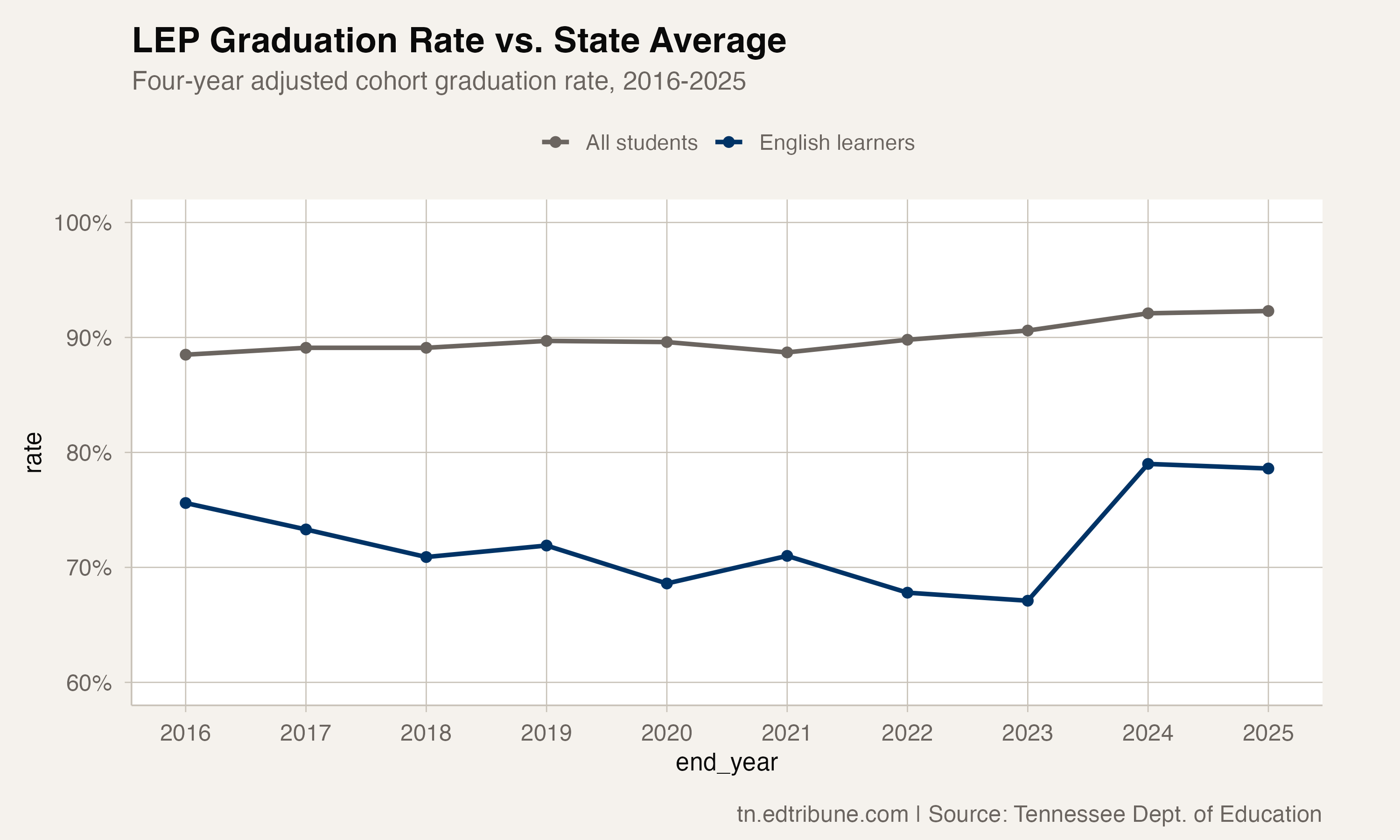
The LEP graduation rate started the data window at 75.6% in 2016 and reached 67.1% in 2023. It was 79.0% in 2024 and 78.6% in 2025.
The state average moved from 88.5% in 2016 to 92.3% in 2025. The LEP gap was 23.5 points in 2023, 13.1 in 2024 and 13.7 in 2025.
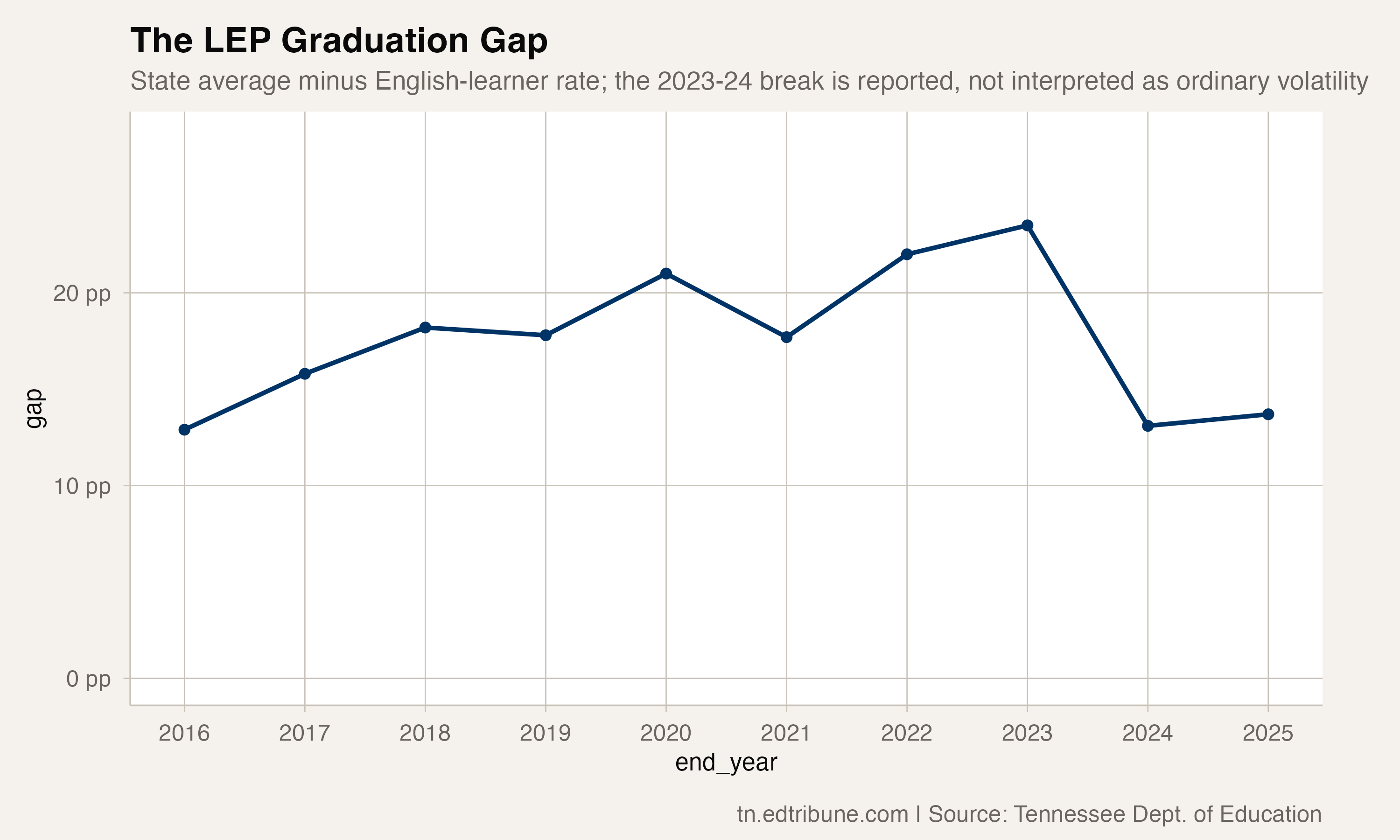
The gap peaked at 23.5 points in 2023 and narrowed to 13.7 points in 2025. That improvement is real, but the current gap is still wider than it was in 2016.
In 2025, the LEP gap was 13.7 points. For comparison, the white-Black gap was 5.8 points, the poverty gap was 6.3 points, the gender gap was 3.3 points, the special-education gap was 9.2 points and the foster-care gap was 35.4 points.
A cohort that has more than tripled
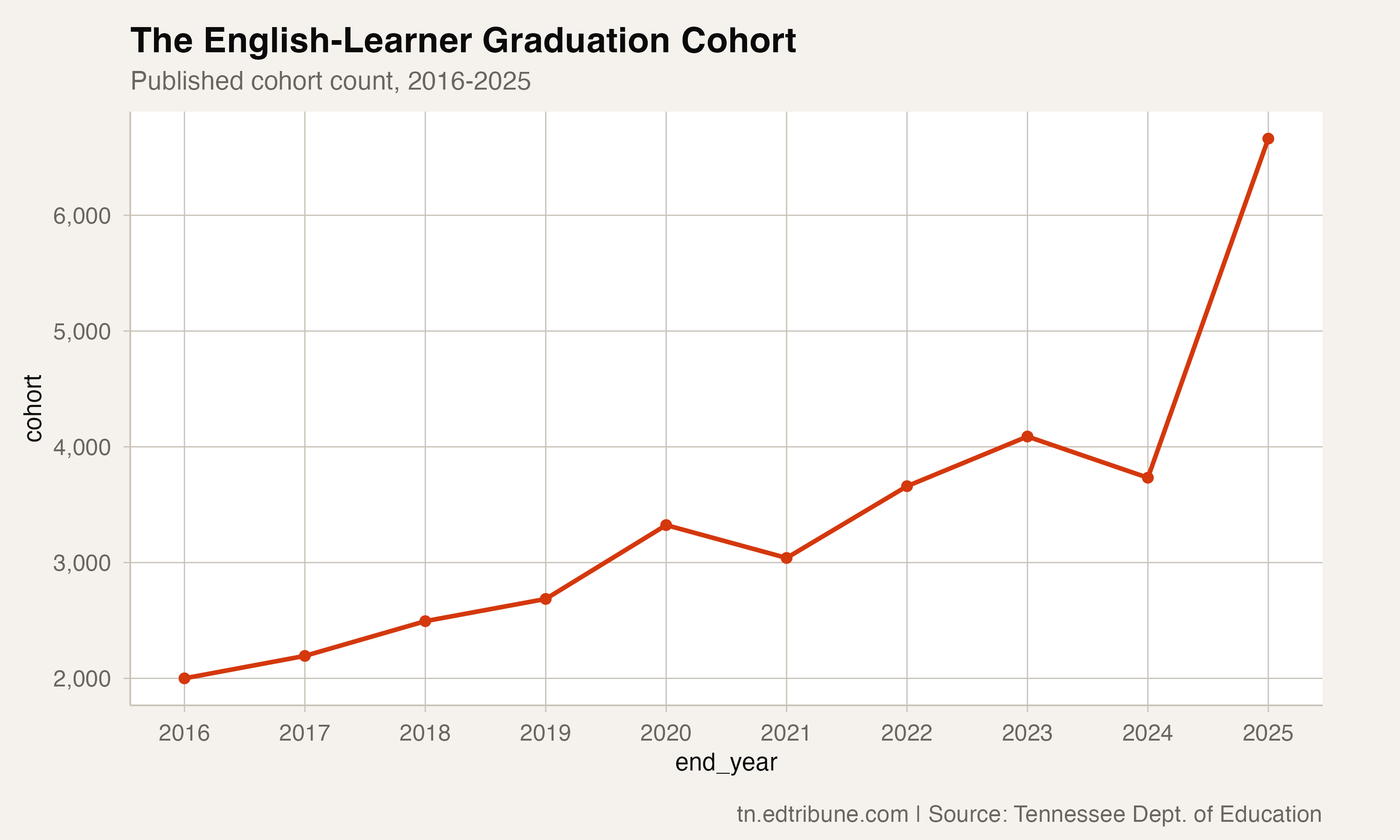
In 2016, Tennessee's LEP graduation cohort was 2,000 students. By 2025, it had grown to 6,662 — a 233.1% increase. The cohort grew from 3,733 in 2024 to 6,662 in 2025, an increase of 2,929 students, or 78.5%.
The 2025 LEP cohort was 8.9% of Tennessee's 74,865-student statewide cohort. At the state average rate, the 2025 LEP cohort would have produced about 912 more graduates than the 5,237 reported.
The changing cohort size means the rate series should be read alongside the cohort counts. The published graduation data do not identify how much of the change reflects student composition, classification, or outcomes.
What the volatility signals
From 2022 to 2023, the LEP rate declined from 67.8% to 67.1%. From 2023 to 2024, it rose to 79.0%; from 2024 to 2025, it dipped to 78.6%. The 2023-24 transition is the flagged series break, so these adjacent changes are not a clean volatility ranking.
Unresourced: The graduation package does not provide language, migration, reclassification, dropout-timing or program-mechanism fields that could explain the observed changes.
The 13.7-point gap in context
The LEP gap is narrower than the foster-care gap but wider than the other four comparison gaps shown above. The cohort growth and the flagged series break are reasons to avoid treating the latest rate as a complete account of English-learner experience.
Detailed code that reproduces the analysis and figures in this article is available exclusively to EdTribune subscribers.
Discussion
Sign in to join the discussion.
Loading comments...