Students experiencing homelessness in Tennessee graduated at 82.0% in 2025, up from 73.6% in 2018, a gain of 8.4 percentage points over seven years. The improvement narrowed the gap to the state average from 15.5 points to 10.3 points, and it came on a growing cohort: 3,055 students experiencing homelessness were in the class of 2025, up 37% from 2,232 in 2018.
In a state where students in foster care graduated at 56.9% in 2025 and the Achievement School District at 40.9%, students experiencing homelessness are on a markedly better trajectory than other groups Tennessee reports separately.
Recovery from a pandemic trough
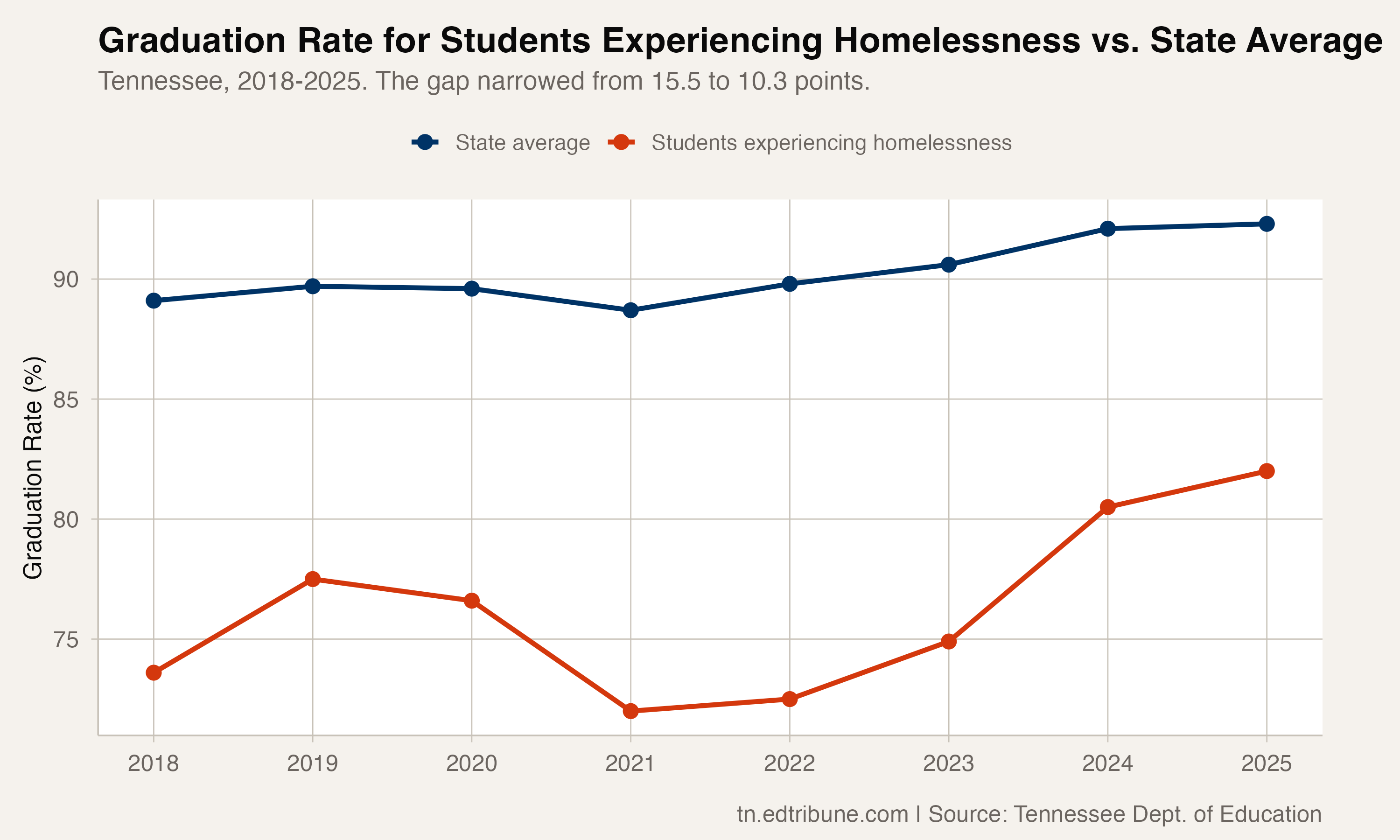
The pandemic hit students experiencing homelessness harder than most groups. Of the 21 subgroups Tennessee published in both years, only students classified as migrant fell further. The graduation rate dropped from 77.5% in 2019 to 72.0% in 2021, a loss of 5.5 points that wiped out the 3.9 points gained since 2018 and left the rate 1.6 points below where the published series begins. The state average dipped only 1.0 point over the same period.
The recovery since 2021 has been substantial: 72.0% to 82.0%, a gain of 10.0 points in four years. Among the subgroups Tennessee published in both 2021 and 2025, only students receiving special education services gained more, at 12.9 points.
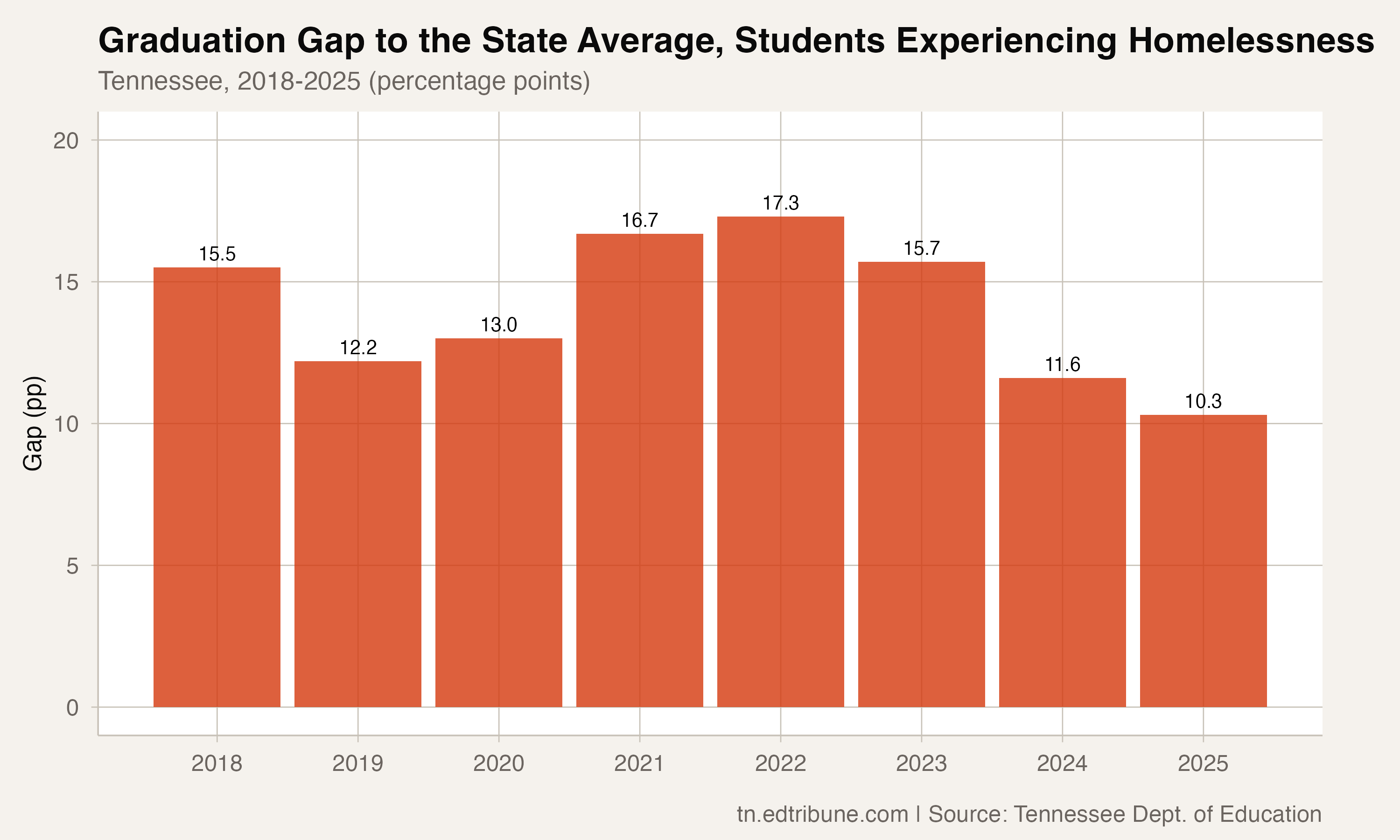
The gap expanded during the pandemic, peaking at 17.3 points in 2022, wider than the 2018 starting point of 15.5. The narrowing since then has been sharp enough to push the gap to 10.3 points, the lowest in the eight years the state has published the group.
How the group compares with others Tennessee reports
The contrast with students in foster care is one of the sharpest in Tennessee's graduation data. Both groups face housing instability. But students experiencing homelessness, defined under the McKinney-Vento Act as lacking a fixed, regular, and adequate nighttime residence, graduated at 82.0% in 2025, while students in foster care graduated at 56.9%. The 25.1-point difference is consistent with the additional disruptions of state custody (court proceedings, caseworker turnover, placement changes) compounding the effects of housing instability, though the published data cannot establish that.
Students experiencing homelessness also graduated at a higher rate than English learners, who finished at 78.6%. A student without stable housing may lack a quiet place to study, consistent meals, or transportation. Why that group finishes ahead of students whose primary barrier is language proficiency is not a question the graduation file can answer.
The McKinney-Vento framework
The federal McKinney-Vento Homeless Assistance Act requires every school district to appoint a liaison responsible for identifying students experiencing homelessness and ensuring they can enroll, attend, and succeed in school. Students are entitled to remain in their school of origin even after moving, and districts must provide transportation to make that possible.
These protections (school stability, transportation, immediate enrollment) address some of the mechanisms that disrupt academic progress. A student who can stay in the same school, with the same teachers and peers, faces fewer of the transition costs that come with a change of placement.
Whether Tennessee's McKinney-Vento implementation is particularly effective, or whether the improvement reflects broader changes in how schools serve students without stable housing, the data cannot say. What it does show is that the state average rose only 3.2 points over the same seven years, so the 8.4-point gain is not simply the statewide trend.
A growing cohort
The cohort grew from 2,232 in 2018 to 3,055 in 2025, a 37% increase, and its share of Tennessee's graduating cohort rose from 3.1% to 4.1%. The graduation file records how many students were identified, not why, so it cannot separate a real increase in student homelessness from improved identification. Doubled-up housing, motels, and shelters all qualify under McKinney-Vento.
That distinction matters. If the added students were mostly already on track to graduate and had simply not been identified before, a rising rate would say more about counting than about outcomes. The year-by-year figures cut both ways. The largest single-year gain, 5.6 points in 2024, came on a cohort that grew by 8 students, which no change in identification can explain. The 2025 cohort, by contrast, added 368 students and 341 graduates, a marginal rate of about 93%, above the state average of 92.3%.
The 10.3-point gap that remains
At 10.3 percentage points, the gap to the state average is narrower than the 13.7-point gap for English learners. It is wider than the gaps measured between groups and their counterparts: 6.3 points between students who qualify for free or reduced-price lunch and students who do not, 5.8 points between white and Black students, and 3.3 points between girls and boys. Of the 3,055-student cohort, 2,505 graduated, leaving 550 who did not.
Tennessee's published rate for students experiencing homelessness has risen on a growing cohort, and the gap to the state average is the smallest the state has recorded for the group. Closing what remains would have meant about 315 more graduates in the class of 2025.
Graduation rates come from the Tennessee Department of Education's graduation data downloads. All rates are four-year adjusted cohort graduation rates, and the state's published figures for students experiencing homelessness begin with the 2017-18 cohort.
Detailed code that reproduces the analysis and figures in this article is available exclusively to EdTribune subscribers.
Discussion
Sign in to join the discussion.
Loading comments...